
The European Smart Networks and Services Joint Undertaking (SNS JU) plans to allocate approximately 220 million euros for the upcoming 6G research and innovation project call, which will be the last one in the current European Union multiannual budget period. This was announced by Erzsébet Fitori, Executive Director of the SNS JU, on October 22, the second day of the international digital connectivity and technology forum “Techritory 2026,” in Riga.
630 million euros have already been invested in the development of 6G in Europe
Eržēbeta Fitori noted that 100 projects have been launched so far under the European 6G research program, with 630 million euros in EU funding invested. Once all eight planned project rounds have been implemented, that number will rise to approximately 120.
“6G will not simply be another faster radio access network. It will be the nervous system of the artificial intelligence economy. The network will have built-in computing power, and it will be the first communications technology in which artificial intelligence is built in from the very beginning,” Fitori emphasized.
She explained that 6G networks will also be able to sense their surroundings. They will combine satellite, air, maritime, and terrestrial communications into a single system and provide resilience and coverage unlike any previous generation of communications. This will open up new opportunities for defense, autonomous transportation and drone swarms, ports and logistics, industry, and agriculture.
One example is precision agriculture. Fitori mentioned a solution supported by the SNS JU that enables a 33% reduction in water used for irrigation. The program is aligned with the global standardization timeline – the full definition of the 6G system is expected by March 2029 from the international standardization organization 3GPP.
SNS JU is an institutionalized public-private partnership established by the European Commission and the 6G Industry Association (6G-IA). During the current multiannual financial framework, 900 million euros from the “Horizon Europe” program have been allocated for its research and innovation activities, and an equivalent investment from the private sector is also expected.
220 million euros – the last major call for proposals in this budget period
The SNS JU program will conclude the current multiannual budget period with a call for proposals offering approximately 220 million euros in funding. It is planned to support about 20 new projects, which will begin in 2028.
The draft 2027 work program includes AI-based smart networks, an AI platform for telecommunications, optical connectivity for large-scale AI needs, quantum-secure communication, microelectronics, the integration of satellite and terrestrial networks, and large-scale trials in collaboration with industry. A new SNS JU flagship project is also planned to replace the concluded Hexa-X-II, as well as international collaboration projects, including one with Taiwan in the field of artificial intelligence radio networks (AI-RAN).
“Compared to previous work programs, we are placing a strong emphasis on large-scale trials in collaboration with industry, as the technology is maturing. We want to pave the way from the lab to the market,” explained Fitori.
She emphasized that the work program is still a draft and the topics are indicative. The SNS JU Board plans to approve it in late December and launch the call for proposals in January 2027.
Fitori also revealed that SNS JU has compiled a list of the program’s ten most significant technological achievements in 2026 – which will be presented at a separate seminar – while an overview of all projects is available in the publication “SNS JU Journal 2026.”
Hamburg and Latvia strengthen cooperation on cybersecurity and digital infrastructure
Carola Veit, President of the Hamburg Parliament, emphasized that due to Russian aggression, hybrid attacks, and cyberattacks, the situation in Latvia, Hamburg, and throughout Europe is becoming increasingly tense. Therefore, joint solutions are needed in the areas of artificial intelligence, cybersecurity, public administration technology, and infrastructure digitization.
Veit arrived in Riga with a large delegation of politicians and business leaders from Hamburg. She noted that Hamburg and Latvia wish to expand their cooperation in the Baltic Sea region, particularly in the areas of maritime security, cybersecurity, and the defense industry. The partnership has existed since the 1990s and has strengthened significantly in recent years—last fall, a 170-person delegation from Riga visited Hamburg.
As examples of this cooperation, Faite cited the memorandum of understanding between the ports of Hamburg and Riga on the digitization of port infrastructure and sustainable logistics, as well as cooperation in aviation – which she linked to the “airBaltic” Airbus A220 fleet and Hamburg’s role as an aviation hub, as well as agreements between Riga Technical University, Riga Business School, and the Latvian IT Cluster with Hamburg’s artificial intelligence cluster ARIC and the Hamburg European Digital Innovation Center. During her visit to Riga, Faite also met with the Speaker of the Saeima.
“Here, we are working together toward a secure future for Europe,” Faite emphasized, calling for strengthened cooperation not only in politics and business, but also in science, education, and culture.
A new cooperation platform with the World Government Summit is planned for the Baltic region
Mohamed AlSharhan, Executive Director of the World Governments Summit, who also represents the Office of the Prime Minister of the United Arab Emirates, announced plans to establish, in collaboration with “Techritory,” a dedicated cooperation platform for the Baltic region and the World Governments Summit in the United Arab Emirates.
The goal of the planned platform will be to bring together leaders, policymakers, innovators, and thought leaders from the Baltic states for discussions on the future of public administration, technology, and society. The aim is not only to showcase the region’s achievements but also to contribute the Baltic perspective to global discussions.
AlSharhan recalled the year 1865, when 20 countries agreed in Paris on common telegraph standards. They did not invent a faster telegraph, but rather a way for different systems to work together. According to him, even today, the greatest obstacle to the next technological revolution may not be technologies yet to be invented, but institutions that still need to be transformed.
“The countries that will benefit most from artificial intelligence will not necessarily be those with the most powerful models. They could be the countries whose institutions are capable of translating intelligence into decisions and decisions into results,” noted Ash Sharhan.
Citing the 2026 World Government Summit’s global ministerial survey, Ash Sharhan noted that 79% of ministers expect the role of government to grow, but only 34% believe their governments have fully embraced the changes. Another study, which surveyed nearly 5,000 public sector employees in 26 countries, concluded: although 58% of those responsible for implementing artificial intelligence are already working on specific projects, only 10% possess the full set of capabilities required for its responsible use on a large scale.
“Techritory” opens a new, international chapter
eils Kalniņš, Director of the “Techritory” ecosystem, recalled that the forum began as a small initiative by the state-owned company “Elektroniskie sakari” in the national interest of Latvia, with the aim of bringing together stakeholders involved in the development of connectivity. It became clear from the outset that Latvia alone was too small for a sustainable ecosystem, so partners were sought in the Nordic and Baltic regions.
After nine seasons, “Techritory” is turning a new, international page. “We want to take our values beyond the borders of Latvia and the European Union,” said Kalniņš.
The ecosystem has already established collaborations with partners in the U.S., Latin America, and Central Asia.
“Values truly make a difference. They will help us survive in difficult times,” emphasized Kalniņš.
The advantage of Latvian companies is their compactness and efficiency
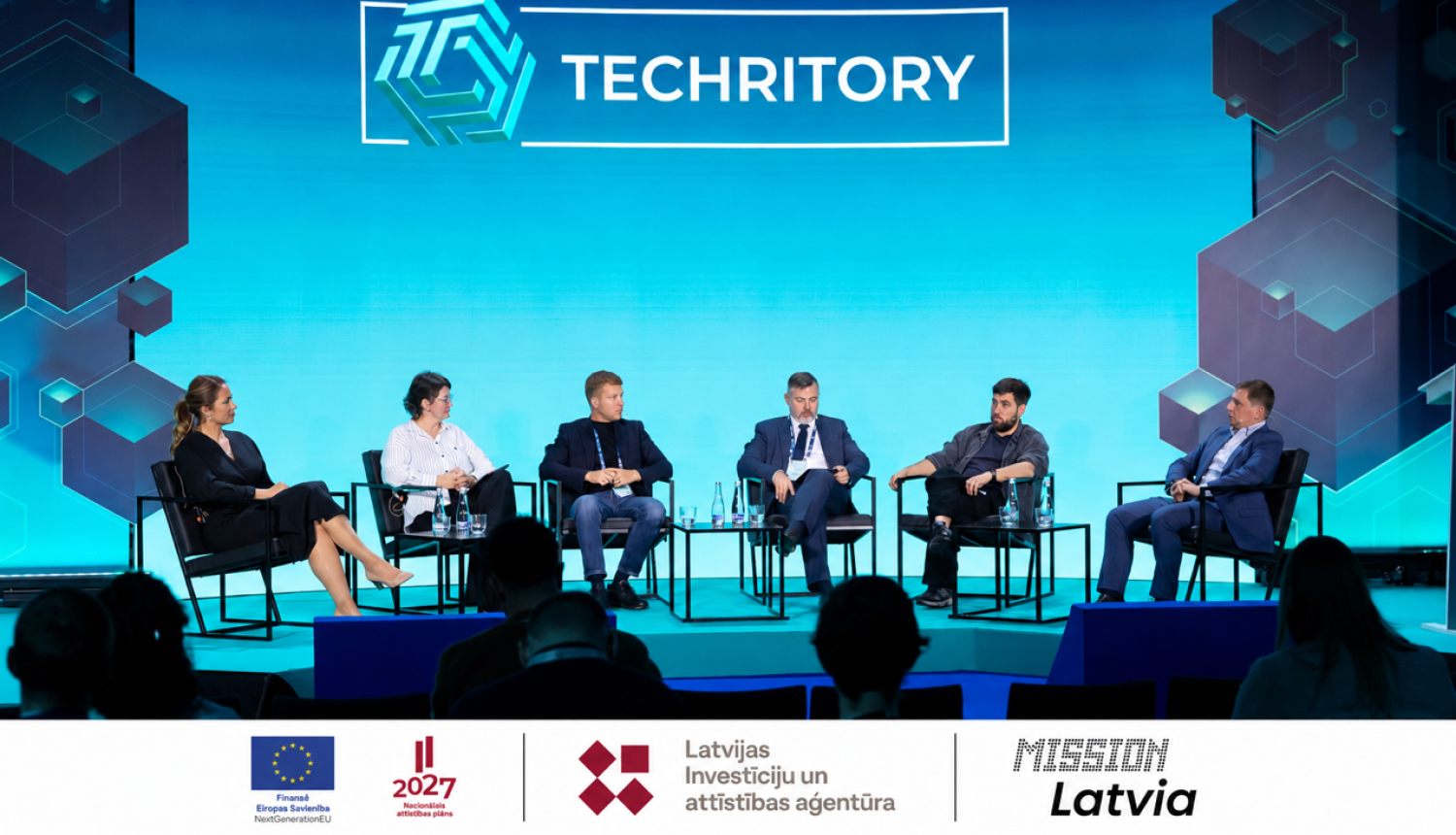
During a forum discussion on the digitization of business, investments, and European partnerships, business representatives emphasized the need to make innovation support programs more flexible and better suited to the technology development process. The discussion was moderated by Egita Aizsilniece-Ibema, head of the Latvian Innovation and Technology Representation in Brussels at the Investment and Development Agency of Latvia (LIAA). She noted that Europe is seeking ways to combine public and private investment so that innovation can develop better and faster.
Artūrs Vasiļevskis, Chairman of the Board at “Tilde,” noted that Latvian companies have the advantage of being compact and efficient. “Tilde” not only utilizes existing technologies but also develops them in-house—the company employs more than ten Ph.D.s. “Tilde” is one of the four winners of the European Commission’s “Large AI Grand Challenge” competition and, using the computing power of the European supercomputer LUMI, has developed “TildeOpen,” an open-source large language model designed for European languages. According to Vasilevskis, there are only a couple of companies in Europe with the expertise to develop large language models from scratch—one in France and “Tilde.”
He emphasized that European research funding provides companies not only with financial support but also with the opportunity to collaborate with leading universities and research centers. Vasiļevskis called on the government to make more proactive use of European funds and to support Latvia’s participation in European artificial intelligence initiatives. He welcomed the fact that the artificial intelligence gigafactory initiative had received support, as it ensures Latvia’s involvement in the development of Europe’s artificial intelligence infrastructure.
Ģirts Slaviņš, CEO of “Mobilly,” pointed out that the most significant obstacles for companies are the complex language used in project applications and restrictions that do not always align with the realities of modern technology development. Smaller companies cannot afford to hire a dedicated person who is familiar with this language and these procedures. “In the innovation process, it is sometimes impossible to know precisely at the outset what the final solution will be and how it will work,” explained Slaviņš. However, in both support programs and procurement processes, the outcome must be described very precisely before work even begins.
Aiga Irmeja, Chair of the Board of the Latvian IT Cluster, who also represents the European Digital Innovation Hub, emphasized that support for digitalization should not focus solely on the most technologically advanced companies. It is equally important to assist a broader range of companies that need to organize their data, streamline internal processes, and implement digital tools.
According to her, approximately 7,000 companies have turned to the center during its first three and a half years of operation. The center worked closely with the national digitization grant program. Irmeja called for support programs in the next planning period to include a quality mechanism that would distinguish between ordinary operating costs and investments in a company’s growth and efficiency.
Andris Kužnieks, Head of the European Commission’s Delegation to Latvia, noted that European competitiveness requires both the development of technologies themselves and the promotion of their use in businesses. He reminded the audience that only about 1% of gross national income is allocated to the EU’s overall budget, so it is crucial where these funds are invested.
Under the Recovery and Resilience Facility, 20% of the funds were to be allocated to the digital sector—a total of approximately 140 billion euros. Not all of the EU’s Digital Decade 2030 goals are likely to be achieved, but Europe’s digital innovation hubs—of which there are more than 200 across the EU—have proven their value and should be continued.
Kužnieks emphasized that the next EU multiannual budget places significant emphasis on competitiveness and digital development. In its proposal for the European Competitiveness Fund, the European Commission has proposed allocating approximately 50 billion euros to digital leadership. The proposal has not yet been approved—the next EU budget is currently being discussed by the leaders of the member states. Since Latvia will remain a net recipient of EU funds in the next period as well, these resources must be used wisely. At the same time, red tape must be reduced to make it easier for companies to apply for funding.
“Latvian companies have the knowledge and technology to contribute to the development of Europe’s next-generation communications, artificial intelligence, and security solutions. By participating in international projects, companies gain the opportunity to work with leading research centers and industry partners, test their developments, and reach new customers. LIAA helps companies find collaboration partners and funding opportunities, and supports the implementation of digital technologies within companies. “The value of European investment will be evident both in the new products we are able to sell globally and in companies’ ability to operate more productively. Techritory provides the opportunity to launch such collaborations right here in Riga,” emphasizes Ieva Jāgere, Director of the Latvian Investment and Development Agency.
“Techritory 2026” is taking place for the ninth time this year. It is organized by the State Joint Stock Company “Elektroniskie sakari,” while its strategic partners are the LMT Group, the Nordic Council of Ministers, “DELSKA,” and the Ministry of Smart Administration and Regional Development.
The event is co-financed by the European Regional Development Fund project “Support for Process Digitization in Latvia” (Project No. 1.2.2.1/1/25/I/001) and the Recovery and Resilience Facility project “Development of a Comprehensive Innovation System Management Model and Its Continuous Operation” (No. 5.1.1.1.i.0/1/23/I/EM/002). The views and opinions expressed are solely those of the author(s) and do not necessarily reflect the views and opinions of the European Union or the European Commission. Neither the European Union nor the European Commission is responsible for them.
