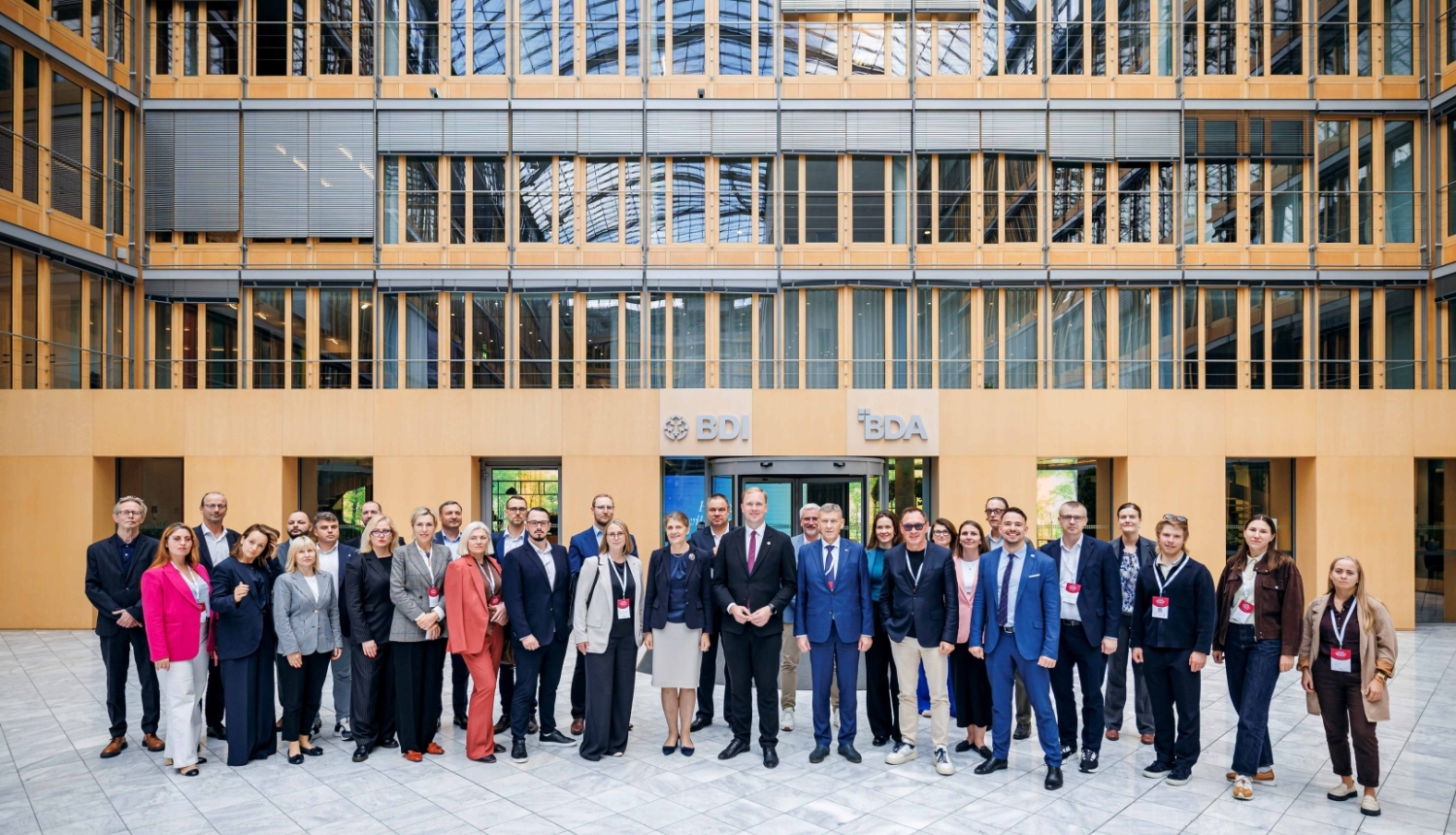
During a trade mission organized by the Latvian Investment and Development Agency (LIAA), Latvian life sciences companies, universities, and medical institutions met in Berlin with German medical technology, biotechnology, and life sciences companies, and research organizations. The delegation introduced German partners to Latvia’s offerings in pharmaceuticals, medical technology, digital health, and the use of health data. Discussions focused on joint product development, clinical research, and opportunities for Latvian companies in the German market.
The life sciences program began on September 16 with the Latvian delegation’s visit to the “Campus Berlin-Buch” science and biotechnology campus and the “BiotechPark Berlin-Buch” biotechnology park in Berlin-Buch. This site brings together biomedical research institutions, clinics, and biotechnology companies under one roof. The Latvian delegation familiarized itself with the infrastructure available for business development and discussed opportunities for collaboration with German researchers and entrepreneurs.
As the delegation’s leader, Minister of Economics Viktors Valainis, emphasized during the visit: “Germany is not a new market for Latvia’s life sciences sector—in 2025, pharmaceutical exports to Germany reached 44.3 million euros. This provides a solid foundation for the next step. Our goal is not merely to sell more finished products, but to build cooperation throughout their entire development cycle—from research and clinical trials to manufacturing, certification, and distribution. Germany’s scientific and clinical capabilities, industrial scale, and market access, combined with the ability of Latvian companies to quickly develop and implement new solutions, can create competitive products for the entire European market.”
Later in the visit, on September 17, the Latvian delegation visited “BIOTRONIK,” a Berlin-based medical technology company that develops cardiovascular care and neuromodulation solutions and operates in more than 100 countries.
From the Biotechnology Park to the Hospital
The program continued with a roundtable discussion between representatives of the Latvian and German life sciences sectors. Companies, researchers, medical institutions, and industry organizations discussed cooperation in the fields of digital health, medical technology, artificial intelligence, health data, and innovative healthcare services. The event was organized in collaboration with the German Association for Eastern Business, the German Health Alliance, and “Berlin Partner,” Berlin’s economic and technology development agency.
“The strength of this delegation lies in its composition—Latvian companies traveled to Berlin alongside hospitals, universities, and research organizations. This allowed them to showcase to their German partners not only individual products but also Latvia’s capabilities across the entire life sciences value chain—from research and the use of health data to the clinical setting and manufacturing. The sector-specific program included visits to research centers, hospitals, and medical technology companies, while individual business meetings allowed companies to engage directly with partners relevant to their specific needs. “LIAA will continue to follow up on the contacts established in Berlin to ensure that the most promising discussions lead to concrete agreements,” says Vita Balode-Andrūsa, Director of LIAA’s Export and Innovation Services Department.
The Berlin-Brandenburg region is one of Germany’s most important centers for life sciences and healthcare. Approximately 22,000 companies operate in the region’s healthcare sector, employing around 410,000 people. In Berlin alone, there are more than 300 biotechnology companies and more than 380 medical technology and digital health companies.
Latvia was represented by companies, hospitals, and research organizations
The delegation of life sciences companies included “ARMGATE,” “Continental Structures,” “Double Helix Technologies,” “GASTRO CENTRS,” “MentatCore,” “Olpha,” “PrintyMed,” and “The Force Latvia.”
The delegation also included representatives from the Latvian University of Biosciences and Technology, the Latvian Academy of Sciences, the National Research and Innovation Institute, the Paula Stradiņa Clinical University Hospital, the Riga East University Hospital, Riga Stradiņš University, the Latvian Association of Pharmaceutical Manufacturers, and Turība University of Applied Sciences.
Latvia’s offerings spanned pharmaceuticals, medical devices, biotechnology, health data infrastructure, artificial intelligence solutions for healthcare facilities, and laboratory data integration. Companies in Germany were seeking research and clinical partners, medical device manufacturers and distributors, technology integrators, investors, and opportunities for collaboration in product certification.
For example, the Berlin-based company “ARMGATE” presented “INCORI HeatGuard,” a thermal care system for newborns developed in Latvia. It is designed to maintain a stable temperature for newborns both in a crib and during skin-to-skin contact with parents. The company was seeking partners in Germany for the product’s further development, certification, clinical testing, manufacturing, and distribution.
“Latvia has particularly strong expertise in pharmaceuticals, biomaterials, precision medicine, biomarker research, and diagnostic solutions, as well as in medical technologies and digital health. It is precisely in these areas that we see the greatest export potential. We already have a solid foundation for cooperation with Germany—the RSU branch in Stade. Riga Stradiņš University (RSU) can help German partners develop solutions for earlier and more precise diagnostics, as well as facilitate the testing and validation of new health technologies in a simulation environment and in collaboration with clinical partners. “We are open to collaborating with German companies, universities, and hospitals on joint product development, research, technology commercialization, and the implementation of international research and innovation projects,” said Agnese Oļševska, Director of the Innovation Center at Riga Stradiņš University, commenting on the visit.
Photo Gallery: Latvian Entrepreneurs in Germany - Life Sciences Program
©️ Photothek/LIAA
The trade mission covers several technology sectors
The trade mission of Latvian businesses to Germany, organized by the LIAA, is taking place from September 14 to 17. Fifty-three Latvian companies and organizations are participating, representing information and communication technologies, financial technologies, life sciences, as well as defense and dual-use technologies. The program is organized by sector, with company visits and joint events complemented by individual business meetings.
Germany is Latvia’s largest export market outside the Baltic states. Since 2020, Latvia’s exports of goods and services to Germany have grown by more than 40%—from 1.47 billion euros to approximately 2.1 billion euros in 2025. Last year, Latvia exported more to Germany alone than to the U.S., France, and China combined. Growth is continuing this year as well: in the first half of 2026, exports to Germany increased by 11%, while Latvia’s total exports rose by 6%. Germany is also Latvia’s largest market for service exports—in 2025, service exports reached 779 million euros. There are more than 1,000 companies with German capital operating in Latvia, with a total investment in share capital exceeding 800 million euros.
Participation in trade missions abroad is organized by the LIAA as part of the European Union-co-financed Program for the Development of Innovative Entrepreneurship in Small and Medium-Sized Enterprises (SMEs), with support from the European Regional Development Fund and state funding. A company may participate in a trade mission either by paying a fee or by receiving support to cover eligible costs.