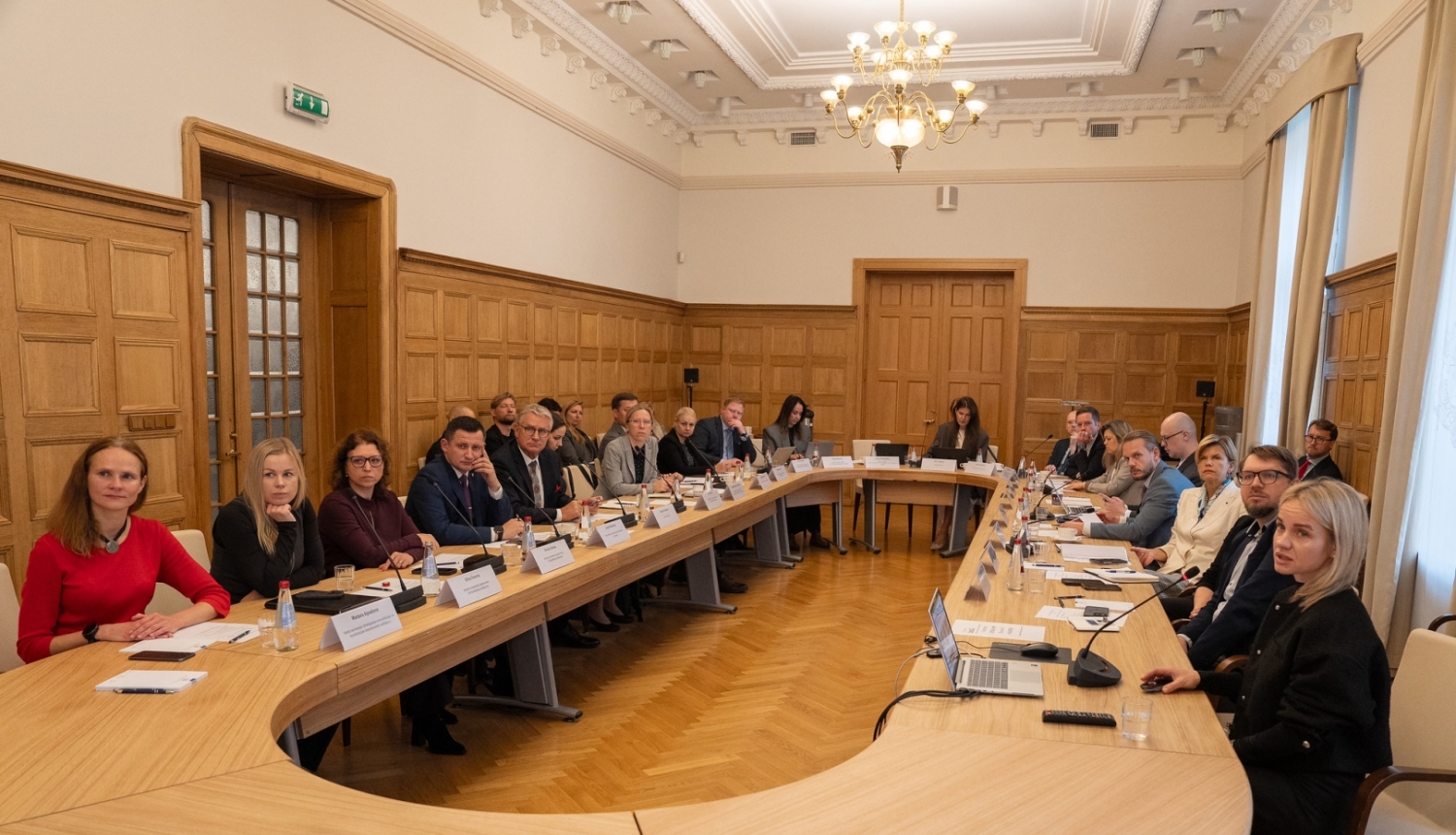
On September 30, 2026, the first meeting of the Latvian Council for the Coordination of Foreign Image Policy (hereinafter referred to as the Council) since 2020 took place at the Ministry of Foreign Affairs, chaired by Foreign Minister Baiba Braže. As the Council resumed its work, discussions focused on inter-agency cooperation to strengthen Latvia’s international recognition and shape the country’s image, including in preparation for Latvia’s presidency of the Council of the European Union in the second half of 2028. The Council meeting addressed issues such as the Council’s future operating model, work on developing Latvia’s national image strategy for 2027–2031, current developments regarding Latvia’s presidency of the Council of the European Union, and related public diplomacy initiatives.
Foreign Minister Baiba Braže emphasized that developing Latvia’s national image is a shared responsibility of all state institutions and cooperation partners. Therefore, a unified and coordinated strategy for Latvia’s national image must be implemented, creating synergy between the Investment and Development Agency of Latvia (LIAA) and the relevant state and local government institutions, the diaspora, the non-governmental sector, and the business community, in order to strengthen the country’s international recognition, ensure a consistent and sustainable message about Latvia in the international arena, and promote the effective use of public resources.
She noted: “In developing the national image strategy, it is necessary to integrate, at an early stage, the most significant events already known regarding Latvia’s international visibility and communication, including Latvia’s presidency of the Council of the European Union, the Summer Olympic Games in Los Angeles, the 28th All-Latvian Song Festival and the 18th All-Latvian Dance Festival, as well as other national and international events,” emphasizing that, for this reason, a national image strategy that is coordinated in a timely manner and implemented over the long term is a prerequisite for creating a sustainable international image and lasting benefits even after the presidency concludes.
For his part, Jurģis Miezainis, Parliamentary Secretary of the Ministry of Economics, noted: “It is important for Latvian entrepreneurs that our country’s reputation helps open doors to export markets and attract investors. In developing the country’s image, we must continue to build on our strengths and the achievements of our businesses, ensuring coordinated work among institutions. Latvia’s presidency of the Council of the European Union will provide an opportunity to showcase our economic potential even more broadly and to forge new partnerships.”
During discussions on the Council’s future operating model and tasks, it was decided that the Council will henceforth serve as a platform for political and inter-institutional coordination on issues requiring joint action by multiple institutions.
The LIAA will continue to lead the development of the country’s image within the scope of its authority. The institutions represented on the Council will help harmonize Latvia’s international communications and apply the common principles of the country’s image in their own work and that of their subordinate agencies.
Ieva Jāgere, Director of the LIAA, emphasized at the Council meeting: “The achievements of Latvian companies, scientists, and professionals in other fields form the foundation of our international narrative. The LIAA draws on these achievements daily when engaging with investors, export partners, and tourists. The Council’s work will help align this approach with the activities of other institutions so that Latvia’s representatives abroad can complement each other’s work.” The LIAA proposed adding a representative from the Foreign Investors’ Council in Latvia (FICIL) to the Council’s membership in order to draw more extensively on investors’ experience and perspectives regarding Latvia’s reputation and competitiveness during discussions.
The Council discussed cooperation in preparation for the European Capital of Culture (Liepāja 2027), Latvia’s presidency of the Council of the European Union in the second half of 2028, the upcoming Song and Dance Festival, and Latvia’s participation in the Los Angeles Olympic Games.
Edgars Kiukucāns, Director of the Secretariat of Latvia’s Presidency of the Council of the European Union, provided an update on preparations for the presidency and related public diplomacy initiatives. The discussion emphasized the importance of coordinated communication and Latvia’s representation to ensure that these events strengthen the country’s international visibility. During the Presidency in the second half of 2028, Latvia will host approximately 250 events at various levels, including meetings of heads of state and government, ministers, and experts, as well as sector-specific conferences and seminars. It is expected that up to 20,000 representatives from across the European Union will visit Latvia over the course of these six months.
Laura Andrejeva, Head of the National Brand at LIAA, presented the approach to developing the country’s image. The meeting also discussed the development of Latvia’s national image strategy for 2027–2031, building on previous work and refining it in line with changes in the international environment.
It was decided that the insights expressed during the Council’s discussion would be taken into account in the development of the strategy, and that the Council would be presented with the new strategic concept in early 2027 so that it could provide institutional support for its implementation.
The Latvian Council for the Coordination of Foreign Image Policy is a coordinating body established by the Cabinet of Ministers, whose objective is to ensure coordinated cooperation among government agencies and other institutions for the successful shaping of Latvia’s foreign image. The Council is chaired by the Minister of Foreign Affairs, and the Deputy Chair is the Minister of Economy.
The Council also includes the Minister of Culture, the Minister of Education and Science, representatives of the Office of the President and the Office of the Prime Minister, the Director of the Latvian Institute, the Director of the Latvian Investment and Development Agency, a representative of the Riga Investment and Tourism Agency, as well as the Secretary General of the Latvian Association of Local and Regional Governments, the Director General of the Latvian Employers’ Confederation, the Chairman of the Board of the Latvian Chamber of Commerce and Industry, and a representative of the Diaspora Advisory Council from the association “esiLV.”