


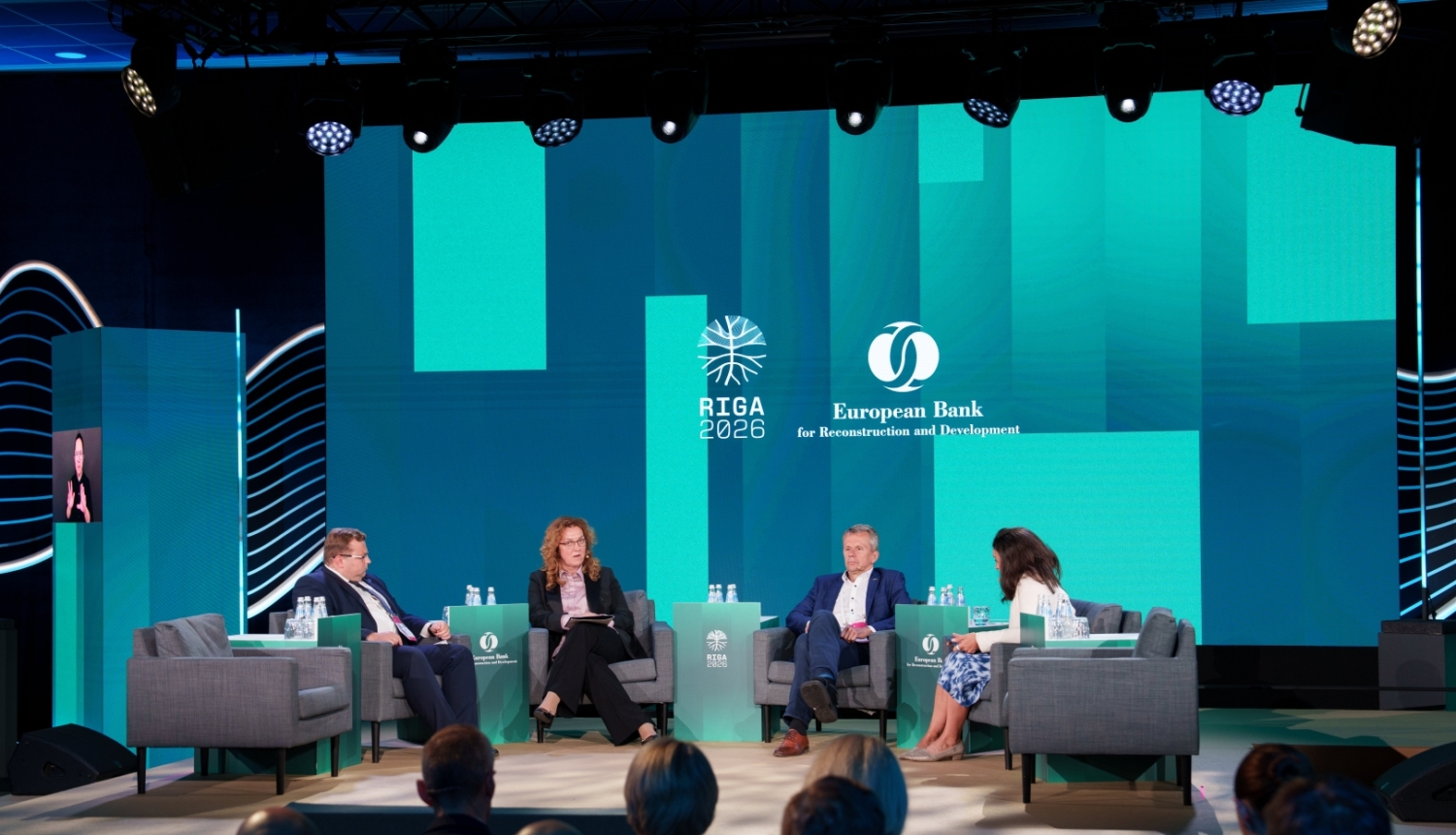
The Baltic states have already demonstrated their ability to generate innovation, attract investor attention and build competitive businesses. The next stage of development, however, will depend on how successfully these strengths can be translated into economic growth, globally competitive companies and major investment projects. This was the key message emerging from the European Bank for Reconstruction and Development (EBRD) panel discussion “Baltic Resilience – Investing in the Future”, held as part of the EBRD’s 35th Annual Meeting and Business Forum in Riga.
Opening the discussion, EBRD First Vice President Gregory Guyett emphasised that the Baltic states have already proven themselves to be competitive, innovative and resilient economies. At the same time, he noted that the next challenge is to convert these advantages into greater economic scale by attracting more long-term investment, encouraging stronger private capital inflows and further strengthening the Baltics’ position within the international investment landscape.
Latvia’s Minister of Economics Viktors Valainis stressed that the future competitiveness of the Baltic states will be closely linked to their ability to transform innovation into commercially successful products and businesses:
“The Baltic states have already demonstrated their ability to build competitive companies and attract investor interest. The next step is to ensure that more ideas developed in the Baltics become exportable products, fast-growing companies and significant investment projects. The ability of businesses to scale, attract capital and compete internationally will be a decisive factor in driving our economic growth over the next decade.”
One of the most tangible outcomes of the EBRD’s 35th Annual Meeting and Business Forum was the signing of a Memorandum of Understanding on the development of a unified Baltic capital market. The initiative aims to strengthen regional cooperation, improve access to capital for businesses and enhance the Baltic states’ attractiveness in the eyes of international investors.
LIAA Director General Ieva Jāgere noted that the message emerging from the EBRD discussion accurately reflects the next stage of development for both Latvia and the wider Baltic region:
“Today, it is not individual countries that compete, but innovation ecosystems that successfully combine talent, knowledge, capital and entrepreneurial ambition. In this respect, the Baltic states possess significant advantages – a digitally advanced environment, a highly skilled workforce, strong technological capabilities and growing investor confidence. This is precisely why the memorandum signed during the EBRD Annual Meeting and Business Forum on the development of a unified Baltic capital market is so important. It represents a practical step towards deeper Baltic economic integration, improved access to capital for businesses and stronger regional competitiveness in the eyes of international investors.”
This trend is also reflected in Latvia’s investment attraction results. In 2025, with the support of LIAA, 31 investment projects worth more than EUR 1 billion were launched in Latvia, representing the largest annual volume of investment attracted in the country’s history.
Participants agreed that the future competitiveness of the Baltic states will depend on their ability to concentrate resources in high value-added sectors, accelerate the commercialisation of innovation, improve access to capital and strengthen regional cooperation. Particular emphasis was placed on the region’s strengths, including digital advancement, a business-friendly environment, the ability to adapt quickly to change and a strong international outlook among companies from an early stage of development.
In LIAA’s view, the panel discussion “Baltic Resilience – Investing in the Future” confirmed that the Baltic states have firmly established themselves as a competitive, innovative and attractive destination for investors. At the same time, the discussion highlighted the next phase of development: deeper regional cooperation, greater capital market integration and a significantly stronger ability to transform innovation into investment, exports and globally competitive companies.