


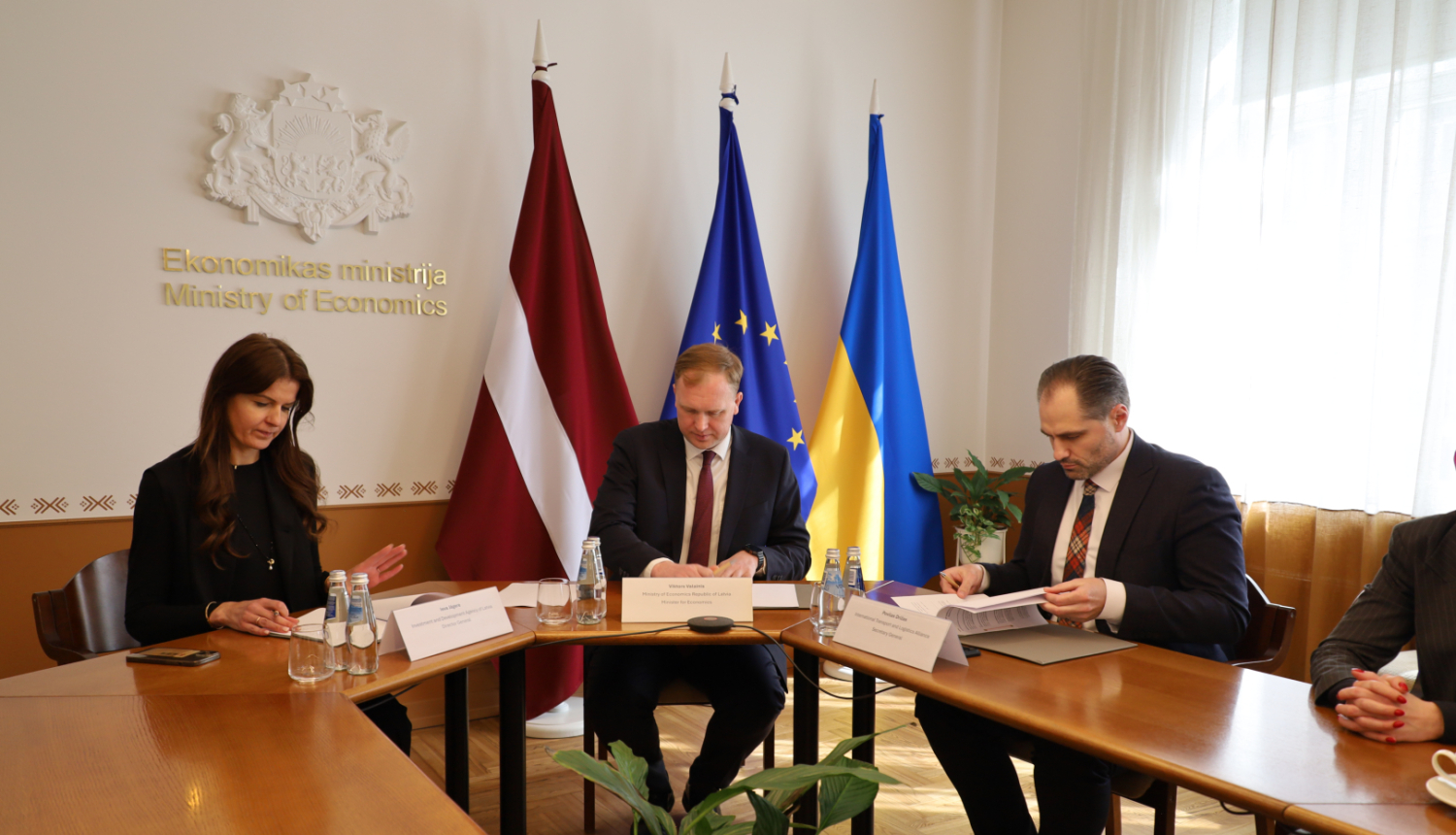
On 1 April 2026, a Memorandum of Understanding (MoU) on the promotion of long-term investment in Latvia’s transport and logistics sector was signed at the Ministry of Economics. The memorandum was signed by Minister of Economics Viktors Valainis, Director General of the Investment and Development Agency of Latvia (LIAA) Ieva Jāgere, and Povilas Drižas, Secretary General of the International Transport and Logistics Alliance (Tarptautinio transporto ir logistikos aljansas – TTLA). The objective of the memorandum is to facilitate the expansion of Lithuanian transport and logistics companies in Latvia, strengthening regional cooperation and developing a competitive transport and logistics ecosystem in the Baltics.
The International Transport and Logistics Alliance (TTLA), founded in 2019, unites 25 of Lithuania's largest transport and logistics companies and represents a significant share of the international road freight market. The organization works to enhance the sector's competitiveness and represent business interests at both national and international levels. TTLA members are international hauliers operating in European and Asian markets, forming a vital link in the Baltic region’s logistics chains.
"The foundation of Latvia's economic development lies in investment, productivity, and exports, and this memorandum is a concrete step toward realizing these priorities. The transport and logistics sector is one of the pillars of Latvia's competitiveness, and such cooperation with a strong regional partner proves that Latvia can attract significant, scalable investment projects. Our goal is to create a stable, predictable, and competitive business environment for investors, where it is possible to launch operations quickly and develop projects in the long term. These projects not only strengthen Latvia's position in the Baltics but also create new jobs, increase tax revenues, and drive export growth," emphasizes Minister of Economics Viktors Valainis.
The memorandum envisages promoting the expansion of TTLA member companies in Latvia, including the establishment of new enterprises and the development of existing operations. Within the framework of this cooperation, investments are planned for infrastructure—including the establishment of offices, driver training capacity, and recruitment—as well as the development of operational capacities in transport and logistics.
The memorandum also outlines the gradual development of a vehicle fleet in Latvia, with plans to register and operate up to 1,000–2,000 trucks and create new jobs in administrative and technical functions. According to investor estimates, these activities could generate up to 32 million euros in annual tax revenue, while simultaneously strengthening Latvia's role in regional logistics chains and promoting economic growth.
"This cooperation is an essential step in turning investor interest into concrete projects with a measurable economic impact. We see that the transport and logistics sector in Latvia has high development potential, and our task is to provide investors with a clear, fast, and predictable path to starting a business. Such projects complement Latvia's investment portfolio and strengthen our ability to attract significant investments, create new jobs, and promote export development," says LIAA Director General Ieva Jāgere.
Latvia's transport and logistics industry is one of the most strategically important sectors of the national economy, ensuring the country's connectivity with European and global markets. Situated between Northern Europe, Western Europe, and Eastern markets, Latvia's infrastructure—ports, railways, roads, and the airport—forms an integrated logistics ecosystem. Road freight transport plays a particularly significant role, providing flexible and internationally competitive movement of goods, as well as transit and export flows.
"This memorandum confirms a shared ambition to strengthen Latvia's transport and logistics sector by fostering new investments and closer cooperation. Lithuanian companies are ready to develop their operations in Latvia, collaborate with local partners, and contribute to the Latvian economy, including through increased tax revenues. This is a significant step toward sustainable and long-term economic development," emphasizes Povilas Drižas, Secretary General of the International Transport and Logistics Alliance.
The sector employs tens of thousands of people across several thousand companies, contributing significantly to the country's export capacity and tax base. At the same time, the industry is undergoing structural changes—with the growing importance of digitalization, sustainability, and efficiency—while facing ongoing labor challenges, particularly regarding driver availability. In this context, investments in infrastructure, technology, and human capital are essential to strengthening Latvia's competitiveness and developing it as a regional logistics hub.
