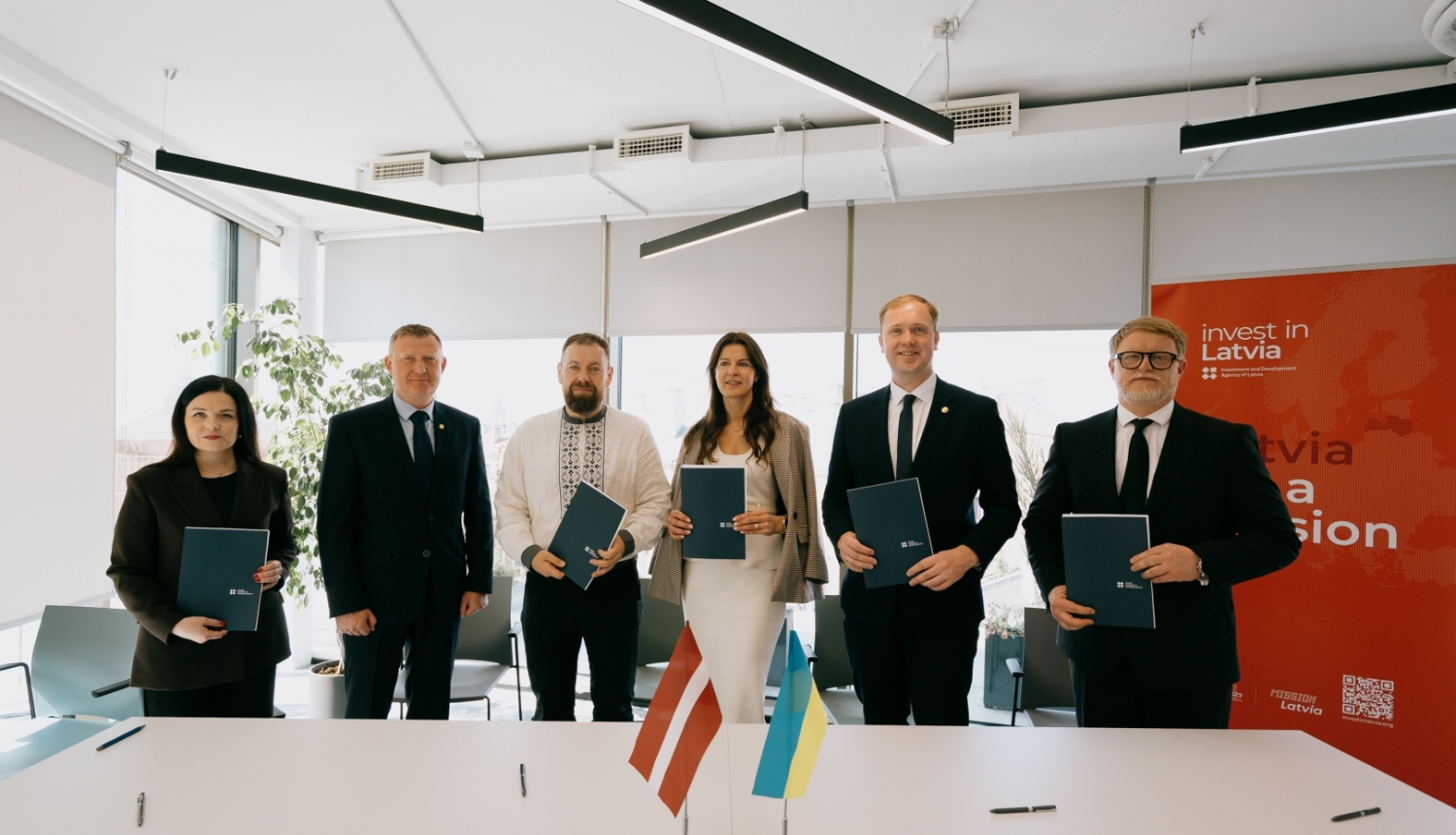
Today in Riga, a significant step was taken toward the development of technological cooperation between Latvia and Ukraine — several memorandums of understanding were signed, providing for the development of investment projects in the production of unmanned systems, technology transfer, and the creation of modern dual-use technology testing infrastructure in Latvia. The agreement is the result of the targeted work of the Ministry of Economics, the Investment and Development Agency of Latvia (LIAA), and other involved partners, strengthening cooperation with Ukrainian technology companies and laying the groundwork for investment projects with high added value for Latvia’s economy. Minister of Economics Viktors Valainis has made a significant contribution to the development of these projects. During a trade mission by Latvian entrepreneurs to Ukraine, he promoted cooperation between companies and institutions in both countries and facilitated the progress of the projects, demonstrating the Latvian government’s interest and readiness to support their implementation and development.
The memorandums were signed by Minister of Economics Viktors Valainis, LIAA Director Ieva Jāgere, and Vadims Juniks, a representative of SIA “Baltic Forces.” Representatives of Ukrainian companies, Riga Technical University Rector Tālis Juhna, and Artis Pabriks, Executive Director of the Latvian Military Technology, Drone, and Robotics Association, also joined the signing of the individual memorandums.
From trade missions to investment projects, Minister of Economics Viktors Valainis emphasizes:
“Today’s agreements are a clear confirmation that the trade mission to Ukraine led by me recently has yielded concrete and practical results. Today we are not talking about a single project, but about several interrelated areas of development—investments in manufacturing, technology transfer, research, testing infrastructure, and international cooperation.
Cooperation with Ukrainian companies, which in recent years have accumulated unique experience in the development of unmanned systems and dual-use technologies, provides Latvia with an opportunity not only to attract investment, but also to acquire knowledge, develop local expertise, and create new export-ready products.
These projects form the foundation for creating a new development environment for unmanned systems and dual-use technologies in Latvia. This means new jobs, investments, export opportunities, and knowledge transfer, which are particularly significant for Latvia’s economic growth and long-term competitiveness.”
The signed agreements cover cooperation on various investment and technology development projects in Latvia, including the development, production, and integration of unmanned systems and their components, technology transfer and expansion of production capacity, as well as the creation of modern demonstration, testing, and innovation infrastructure. Overall, the memorandums lay the foundation for the creation of a new environment for the development, testing, and production of unmanned systems and dual-use technologies in Latvia, promoting investment attraction, innovation development, and high-value-added manufacturing.
LIAA’s work in Ukraine is yielding results, notes LIAA Director Ieva Jāgere:
“The LIAA’s foreign economic representation in Ukraine continues to work actively even under wartime conditions, and we are pleased that several projects, whose origins lie in our daily work with Ukrainian partners, have now reached the next stage of development.
Knowledge-intensive and dual-use technologies are currently among the fastest-growing and most strategically important sectors in Europe. Latvia has every opportunity to become a major center for innovation, testing, and manufacturing in Northern Europe, particularly in the fields of unmanned and autonomous systems, as well as other high-tech sectors, as evidenced by the recent international unmanned technology summit “Drone Summit 2026” held in Riga.
These memorandums confirm that Latvia is capable of attracting partners with unique technological expertise while simultaneously creating an environment where investment, science, entrepreneurship, and innovation converge.”
Defense Minister Raivis Melnis also participated in the signing of the memorandums; he has significantly promoted cooperation between Latvia and Ukraine and helped lay the groundwork for the projects signed today. The exchange of experience and knowledge between experts from both countries has also played a significant role in this cooperation, strengthening the region’s security and competitiveness: “I consider it important to transfer defense technologies and innovations tested in Ukraine to support the development of local industry, as well as to learn from the experience of Ukrainian companies in close cooperation with the armed forces under wartime conditions. It is equally important to strengthen the cooperative ties between Latvia’s industrial and innovation ecosystems and Ukraine, to jointly strengthen supply chains, and to promote competitiveness and integration into the European market.”
The “Baltic Forces Hub” will become a center for innovation and testing, and RTU will gain new opportunities for technology development and testing
One of the memorandums provides for the creation of the “Baltic Forces Hub”—a modern environment for the demonstration, testing, and innovation of dual-use technologies. The project’s goal is to create infrastructure that will allow for the testing of unmanned systems, autonomous technologies, and other innovative solutions under real-world conditions, while fostering collaboration between companies, research organizations, the academic community, and international partners. The project will strengthen cooperation between innovation centers in Latvia, Ukraine, and other partner countries, providing an environment for the development, demonstration, and refinement of new technologies.
“Baltic Forces Hub” is also particularly significant for Riga Technical University, which is already developing several dual-use technology solutions. Unlike military testing grounds, whose use is limited and focused on the needs of the defense sector, the new testing environment will provide broader opportunities for research, prototype development, and technology validation. It will provide students, researchers, and companies with the opportunity to test the latest developments under real-world conditions, while facilitating direct knowledge exchange with Ukrainian engineers and technology developers who have accumulated unique practical experience and expertise in the rapidly growing unmanned and dual-use technology sector.
The new infrastructure will also create additional opportunities for the development of research projects and the establishment of international cooperation, strengthening Latvia’s innovation environment and promoting the creation of new technology companies. At the same time, it will help retain young talent, students, and researchers in Latvia by providing the opportunity to work with world-class technologies and participate in internationally significant projects. Such an environment will strengthen cooperation between academia, industry, and international partners, fostering the development of new technologies, the training of highly qualified specialists, and, in the long term, contributing to Latvia’s economic growth and competitiveness.
Technology transfer from Ukraine will boost manufacturing in Latvia, notes Vadims Juniks, a representative of the company “Baltic Forces”:
“Our goal is to create an environment where knowledge, experience, and innovation drive the creation of new products and manufacturing capacity. Our Ukrainian partners have accumulated unique practical experience, and combining this with Latvia’s manufacturing capabilities will be a significant contribution to strengthening the technological expertise and international competitiveness of both Latvia and Ukraine.”
A separate memorandum provides for the development of an investment project for the design and production of unmanned systems in Latvia in cooperation with the Ukrainian company “GLOBAL DYNAMICS.” Systems developed by the company are already being manufactured in Ukraine and the United Kingdom, while the implementation of the project in Latvia will ensure the expansion of manufacturing capacity, technology transfer, and the development of new competencies in the local industry.
