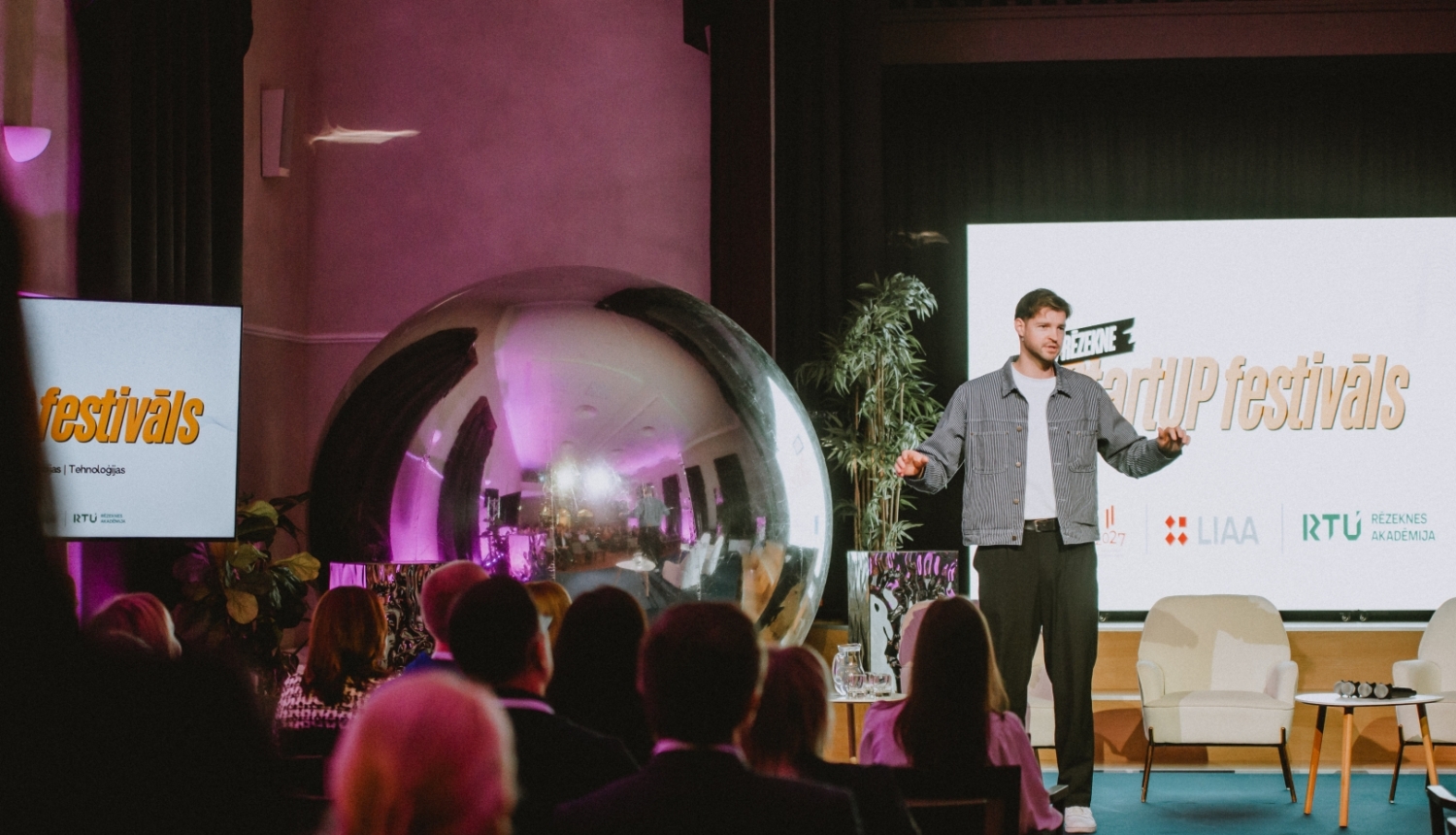
On October 9, the “StartUP Festival” took place at the RTU Rēzekne Academy, bringing together more than 150 startup founders, entrepreneurs, investors, students, and representatives of the innovation ecosystem from all over Latvia. The festival featured discussions on attracting investment, the use of artificial intelligence in business, and the role of universities in creating new companies. At the conclusion of the event, the “theLAB Rēzekne” laboratory was unveiled, where participants will now have the opportunity to develop ideas and build their first prototypes.
During the festival, participants also heard success stories from founders, received advice from investors on securing funding, and were presented with practical examples of how to apply artificial intelligence in business. In a presentation workshop led by entrepreneur Ernests Štāls, participants honed their skills in presenting their ideas persuasively. Meanwhile, five local teams—Webglazer, Busy Tag, Kraftinner, Vitaflow, and SG AI COACH—took the festival stage to showcase their solutions.
“The knowledge of Latvian researchers and specialists evolves and is transformed into products with potential in international markets when ideas are tested in practice early on and refined with customer needs in mind. Startups across Latvia are developing and growing in an environment where researchers, students, and entrepreneurs collaborate. theLAB Rēzekne creates such an environment in Rēzekne. LIAA helps companies throughout Latvia find foreign partners and customers and prepare to enter export markets,” emphasizes Vita Balode-Andrūsa, Director of the LIAA Export and Innovation Services Department.
One of the festival’s central themes was the transformation of ideas generated at universities into businesses. The regulations on the commercialization of intellectual property adopted this summer establish, for the first time, a unified framework for how state scientific institutions can use technologies and inventions created through publicly funded research in business. This provides for the possibility of licensing technologies, transferring rights to them, or investing them in business development. Each institution must also develop its own internal procedures for implementing these options in practice. It is expected that clearer conditions will promote collaboration between universities and entrepreneurs, facilitate the creation of science-based startups, and attract investment.
The importance of universities in the development of new businesses was also underscored by the success stories shared by local entrepreneurs at the festival. Several startup ideas have emerged and continue to develop specifically at the RTU Rēzekne Academy, where the available knowledge and infrastructure help turn ideas into practical solutions. These examples demonstrate that universities can provide significant support for the development of entrepreneurship even outside of Riga.
“The StartUP Festival demonstrated that Latgale has both ideas and people with the ambition to bring them to life. However, for ideas to become real solutions and competitive products, an environment is needed where it is possible to experiment, test, and develop these concepts. That is precisely why the opening of theLAB Rēzekne is a significant step toward strengthening the innovation ecosystem at RTU Rēzekne Academy. “We want the academy to be not only a place for acquiring knowledge, but also an environment where students, researchers, and entrepreneurs collaborate, create prototypes, and develop new technologies,” emphasizes Olga Vindača, Deputy Director for Science and Innovation at RTU Rēzekne Academy.
The “theLAB Rēzekne” laboratory, which will open at the conclusion of the festival, will be yet another place where students and innovators can experiment, build prototypes, and test their ideas in practice. It will complement the opportunities already available at the academy and help develop new technological solutions.
The event was organized by the Investment and Development Agency of Latvia (LIAA) in collaboration with the RTU Rēzekne Academy.
The event was organized as part of the “Program for the Development of Innovative Entrepreneurship in Small and Medium-Sized Enterprises (SMEs),” co-financed by the European Regional Development Fund and the Latvian state budget, and the project “Support for the Improvement of the Technology Transfer System.”