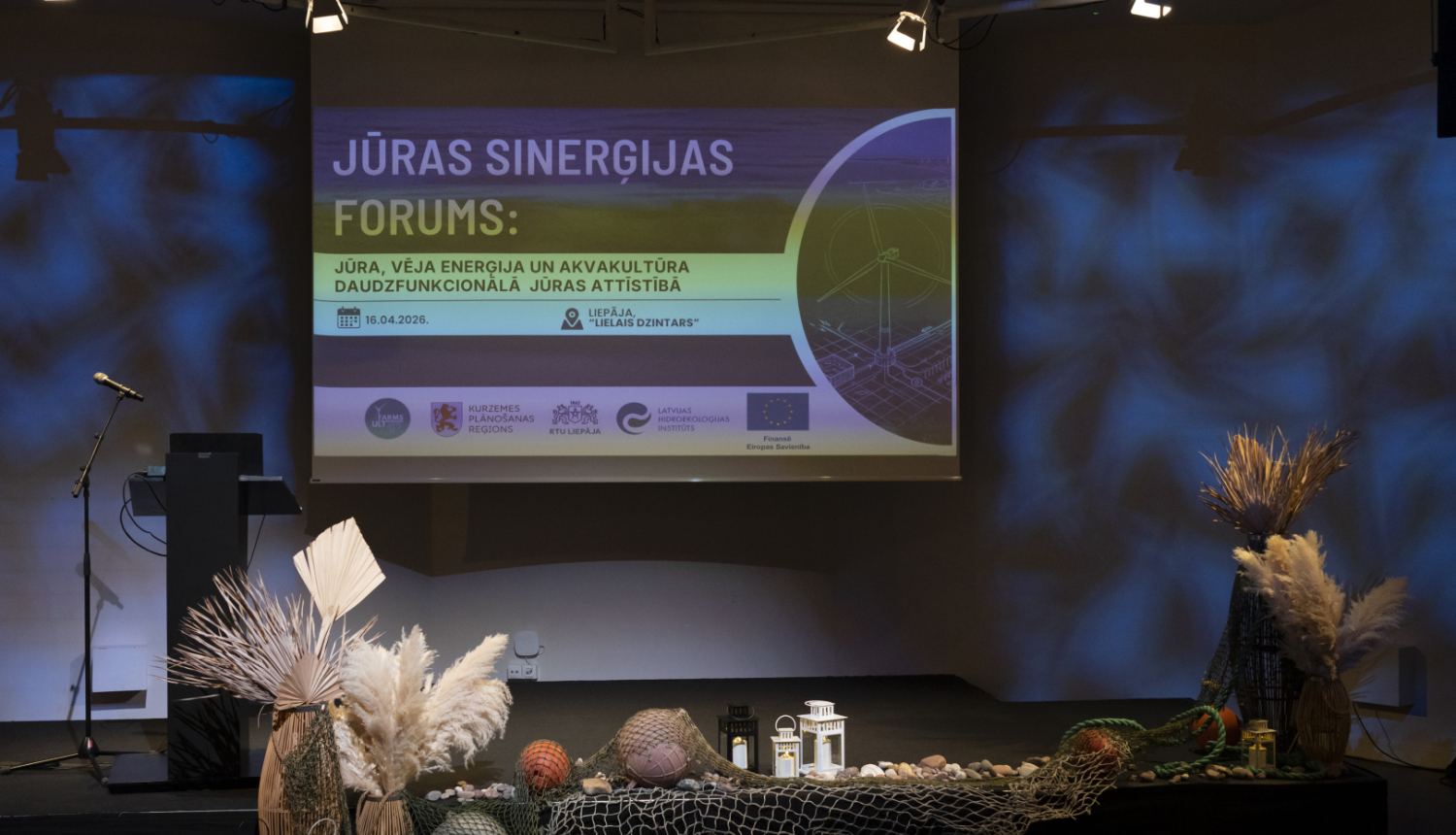
The Baltic Sea is increasingly emerging as a platform for smart growth in Latvia, not only as a natural resource or a geographical boundary. The Blue Synergies Forum in Liepaja showed that the blue economy – offshore wind energy, aquaculture, bioeconomy and marine technologies – can become one of the key directions where Latvia develops high added-value innovation, strengthening competitiveness, exports and regional development. At the same time, recent economic and productivity analyses remind us that, in the long run, living standards and wage growth are closely linked to labour productivity and innovation intensity – this is why the development of the blue economy should be seen as a targeted investment in Latvia’s productivity leap.
Dr. Anda Ikauniece, Lead Researcher at the Latvian Institute of Aquatic Ecology, underlined during the forum that the development of offshore wind and aquaculture in Latvia is not possible without the integration of advanced technologies. Working with marine technology and blue economy topics, and drawing on European and global trend analysis and stakeholder input from Latvia and Estonia, she highlighted several priority directions: autonomous systems and robotics, which ensure marine monitoring and infrastructure maintenance; digital tools and models, including digital twins, which support planning and management of the marine space; technology synergies (multi-use), where offshore wind farms serve as platforms for aquaculture and testing; and alternative energy combined with regenerative aquaculture, which simultaneously produces energy and supports ecosystem restoration. These directions represent a typical knowledge-intensive, high added-value economic segment, where each professional creates substantially higher value and export potential than in traditional sectors.
Zane Gusta, Project Manager at Kurzeme Planning Region and one of the Latvian partners in marine technology and blue economy initiatives, emphasised that technologies cannot develop in a vacuum – a strong innovation ecosystem is needed. Working on cooperation networks around marine technologies and the blue economy in the Baltic Sea region, she highlighted the need to strengthen marine technology research, innovation and knowledge transfer by 2028, by developing a joint blue economy development strategy, policy recommendations for more effective use of marine space, research projects, as well as support instruments for companies – consulting, mentoring and support for pilot projects. Exactly this kind of innovation infrastructure – testing environments, cooperation networks, support programmes – is needed to ensure that ideas become market-ready products and services, rather than remaining at the level of research projects.
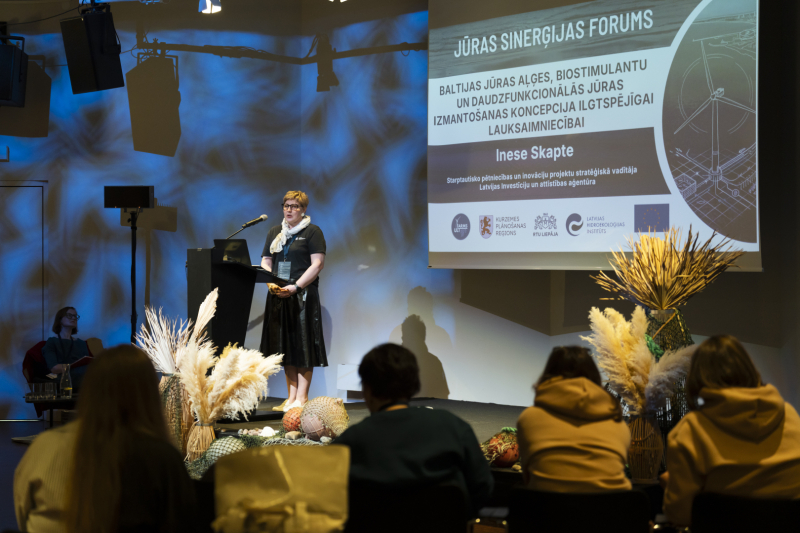
A very concrete example of how the blue economy translates into practical business opportunities was presented at the forum by Inese Skapste, Head of Strategic International Research and Innovation Projects at the Investment and Development Agency of Latvia (LIAA) and Researcher at the Latvia University of Life Sciences and Technologies. Her concept on Baltic Sea macroalgae, biostimulants and multi-use sea space for sustainable agriculture shows how Baltic Sea eutrophication can be turned into a resource. Using macroalgal biomass, biostimulants, biogas and compost can be produced and integrated into Latvian agriculture, reducing dependence on imported mineral fertilisers, decreasing environmental pressure and increasing farm incomes. This is a circular economy approach that simultaneously supports entrepreneurship, export and climate goals, and demonstrates how science-based innovation becomes a real market solution with high added value.
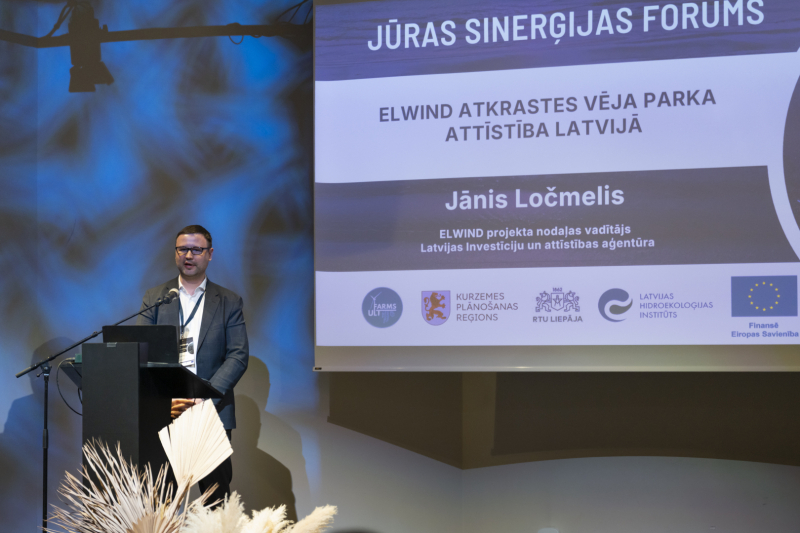
An important perspective at the forum was also provided by Janis Locmelis, Head of the ELWIND Project Unit at LIAA. He highlighted the importance of engineering and regulatory aspects for the development of the blue economy. Janis stressed that for offshore wind farms, aquaculture installations and multi-use solutions to develop in practice, a predictable, clear and innovative-friendly regulatory framework is essential. This means high-quality maritime spatial planning, clearly defined multi-use zones, aligned licensing and safety requirements, as well as opportunities to test new technical solutions in real sea conditions. Such a framework helps to reduce risks, increase investor confidence and encourage long-term investment in high added-value projects.
Taken together, the conclusions of the Blue Synergies Forum align closely with the broader economic and productivity discussion in Latvia. Analytical reports repeatedly stress that the next stage of development will depend on the shift from lower added-value activities to knowledge-intensive solutions. The blue economy stands out as an area where Latvia has the resource (the Baltic Sea), the competences (research institutions, companies and professionals) and concrete projects and initiatives that already demonstrate practical innovation potential – from marine technologies and multi-use concepts to bioeconomy solutions from sea to field.
From LIAA’s perspective, the development of the blue economy is therefore not only an environmental or regional policy topic – it is a question of economic development and competitiveness. By developing offshore wind energy, aquaculture, bioeconomy solutions and marine technologies, Latvia can build new value chains, create high added-value products and services and strengthen its export capacity. This means new jobs, higher value added per employee and, in the long term, a higher standard of living. In cooperation with regions, research organisations and companies, LIAA is ready to continue working to ensure that blue economy innovation becomes a stable pillar of business support and growth in Latvia – both through research and innovation projects, and through export and investment promotion.
Gallery: Jūras sinerģijas forums 2026 (photograph Guna Rubule)