
Last summer, ELWIND – a joint Latvian-Estonian project to develop an offshore wind park in the Baltic Sea – signed an agreement with the Latvian Institute of Aquatic Ecology (LHEI) to study the seabed, benthic organisms, pollution, and sediment transport in the wind park area. This data will help establish the current conditions in the planned wind park area and assess how its future construction and operation could affect the marine ecosystem.
Benthic organisms are organisms that live in or on the bottom sediments of water bodies, as well as on submerged objects. In this case, the researchers focus on the seabed of the Baltic Sea and on seabed organisms visible to the naked eye – macroorganisms, also known as zoobenthos.
They live on the seabed or are buried in the sediment and play an important role both as indicators of environmental conditions and as part of the food chain, as they serve as food for benthic fish (fish that live and feed near the seabed) and other marine animals. These organisms help assess the health of the marine environment and improve our understanding of the processes taking place within the marine ecosystem.
Juris Aigars, Leading Researcher at the Latvian Institute of Aquatic Ecology, explains: “In the context of the ELWIND project, this type of research is particularly important because an environmental impact assessment must first establish the existing baseline conditions – what species live in the specific area, what the seabed is composed of, what the level of pollution is, and how currents or sediment transport may change during construction. Only then is it possible to make a well-founded assessment of the potential impacts and determine what mitigation measures need to be put in place.”
The research has three main directions
The Institute’s work within the ELWIND study is divided into three main areas. The first involves field surveys to determine which organisms, or benthic communities, live on the seabed and within its upper sediment layer.
Alongside the biological surveys, samples are collected for pollution analysis, focusing on priority groups of chemical compounds and their potential behavior during construction or operation. The samples are assessed by specialized laboratories in Sweden, while the zoobenthos samples are analyzed in Latvia. Pollution studies are necessary to determine whether compounds have accumulated in seabed sediments that could be released into the water column if the sediments are disturbed and resuspended during construction.
The third area focuses on modelling currents and sediment transport, which will make it possible to assess whether and how construction activities could affect the movement of sediments in the marine environment and the direction in which resuspended sediment could spread. The modelling will be carried out once information on seabed topography, sediment types, winds, waves, and other relevant conditions has been compiled.
The practical fieldwork at sea was carried out from 8 to 13 June 2026. The expedition involved nine specialists from the LHEI, who worked in shifts aboard the vessel, allowing the research to continue late into the evening and throughout the night.
The seabed is studied using cameras and sediment samples
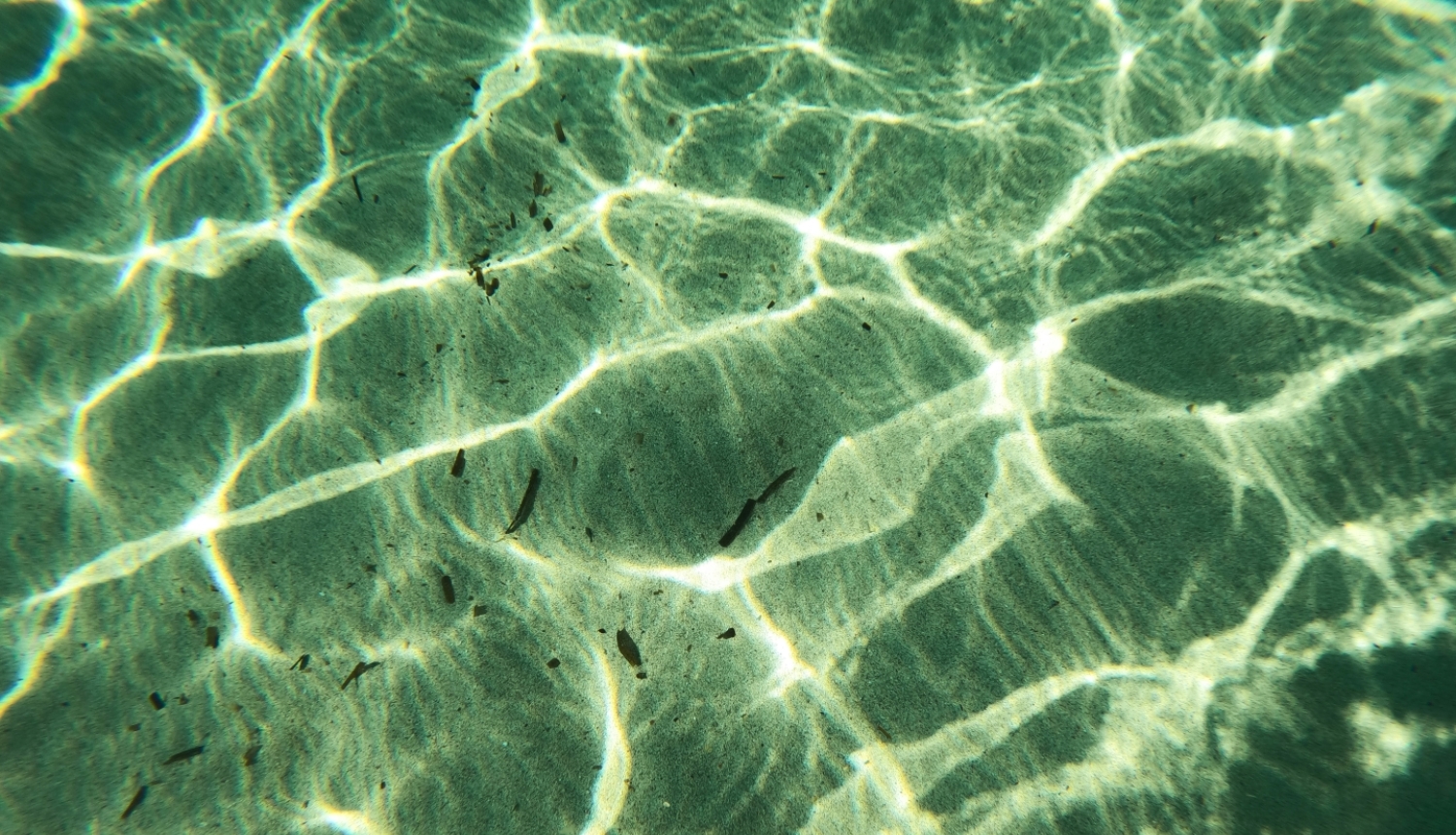
One of the key research methods is underwater filming. Researchers visit 300 survey points with predetermined coordinates, lower an underwater camera to the seabed, and record video at depths ranging from approximately 7 to 70 meters. The footage makes it possible to assess the type of seabed sediment and determine whether it consists of sand, rocks, gravel, or clay-rich glacial till, as well as to document larger organisms and biological growth.
Video surveys were carried out at all 300 locations, while sediment samples were also collected at selected sites. Physical sediment samples are necessary because the camera can only capture what is visible on the seabed surface. Organisms living within the sand or buried in the sediment can only be identified after samples have been collected and analyzed in the laboratory.
A specialized grab sampler is used to collect sediment samples and is lowered into the sea using a winch. It can collect approximately the upper 20-centimetre layer of the seabed. These samples make it possible to determine the species’ composition, abundance of organisms, and their ecological status more accurately.
“This approach makes it possible to combine visual observations with laboratory analysis. Video footage provides an overall picture of the seabed structure, while the samples allow us to determine which species live in a particular substrate. It is precisely this combination that will enable us to draw well-founded conclusions about the baseline ecological value of the ELWIND area,” adds J. Aigars.
What lives on the seabed
Benthic organisms are one of the foundations of the marine ecosystem. They help to indicate the condition of the marine environment, as many species are long lived and respond to changes in water quality, oxygen levels, pollution, and seabed structure.
At this stage, the researchers are not looking for specific species but are documenting those found within the study area. Around 10 to 15 different species may occur in the area, although their composition will depend on location, seabed type, and depth. Seabed samples also make it possible to identify species that live buried in sand or other sediments and therefore cannot be seen in the video footage.
Mussels are particularly important in the Baltic Sea. They filter the water and thereby help improve water quality. In rocky areas, where hard substrate is more abundant, mussels can form denser colonies. In the future, wind park structures could create new vertical surfaces that would most likely be colonized by local species, such as blue mussels.
How can wind park structures change the underwater environment?
Knowing the characteristics of the environment and the organisms that live there makes it possible to predict potential biological changes. International experience shows that the impact of offshore wind parks on the underwater environment cannot be assessed in simple terms. Construction can cause temporary disturbances, such as noise, sediment resuspension, or local changes to seabed conditions. At the same time, wind park foundations and structures also create new hard surfaces that can become colonized by marine organisms, potentially creating a “reef effect”. This can change species’ composition and, in some cases, increase biodiversity.
To assess the potential environmental impact of the planned offshore wind park, it is necessary to study the specific Latvian marine area in detail, including its seabed composition, the organisms living there, and the processes that could change during construction and operation.
Scientific basis for future research
As part of the ELWIND environmental impact assessment, the data collected by LHEI will help answer several key questions: what the current condition of the seabed is, which species and habitats are present in the planned wind park area, whether the sediments contain pollutants, how sediments could move during construction, and what changes could occur after the wind park is built.
Jānis Ločmelis, Head of the ELWIND Project Division at the Investment and Development Agency of Latvia, highlights: “To properly assess how an offshore wind park could affect the marine environment, we first need to understand what lives in the area and what its baseline ecological conditions are. The LHEI study helps build a detailed picture of the underwater environment in the ELWIND area before any construction takes place. This is an important prerequisite for the responsible development of offshore wind energy, ensuring that the project’s environmental impact is assessed scientifically, transparently, and based on concrete data.”
As LHEI emphasizes, this area of the Baltic Sea has not been studied before, so the data collected will be scientifically valuable not only for the ELWIND project but also for future comparisons and for gaining a broader understanding of the underwater environment in Latvia’s open Baltic Sea waters.
About the ELWIND project
ELWIND is a cross-border project between Latvia and Estonia for the construction of an offshore wind park in the Baltic Sea. It is an ambitious and environmentally friendly renewable energy project with a combined capacity of up to 2 GW, which will increase the energy independence and security of the region and keep energy prices reasonable, thus reducing costs for businesses and households. In addition, it will create new business opportunities. ELWIND will help to fill the gap in domestic large-scale renewable energy production and contribute to a better functioning open energy market. The offshore wind park is expected to be built and operational by 2035.
The pre-development work for the ELWIND project will end in 2029 with a planned auction in which the right of use of the offshore wind site will be transferred to a qualified developer. The ELWIND project is implemented by the Investment and Development Agency of Latvia and the Estonian Environmental Investment Centre in cooperation with the Ministry of Economics of the Republic of Latvia and the Ministry of Climate of the Republic of Estonia.