


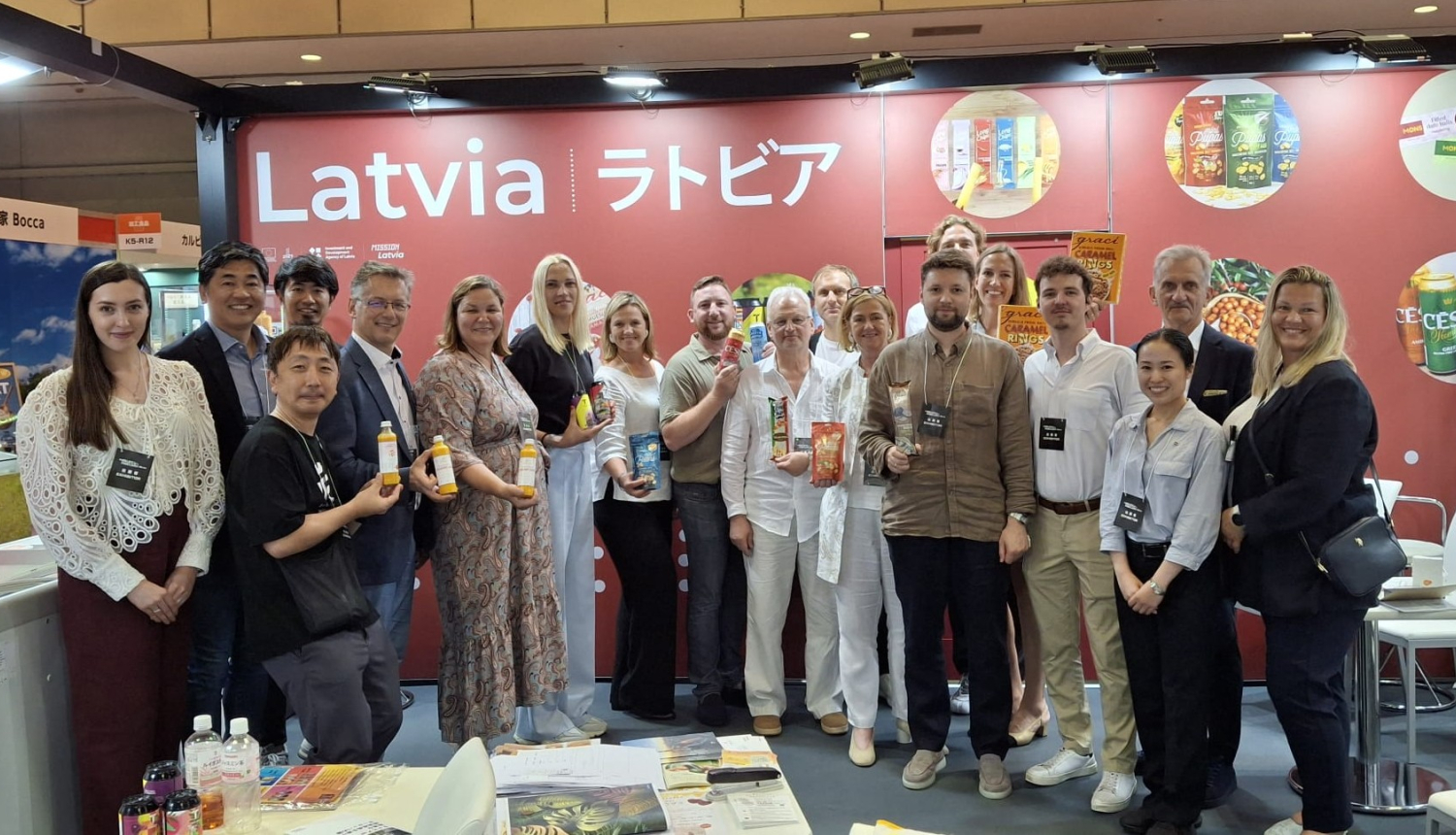
Latvian food companies are asserting themselves more and more confidently in Japan – a market that is often described as one of the most demanding and conservative in the world. However, export results, interest, and feedback on Latvian products show that Latvia has something to offer. This was also evident within the specially designed business programme of “EXPO 2025 Osaka”, where more than 20 Latvian food companies successfully presented themselves. This year has been particularly successful in terms of exports to Japan for Latvian food companies such as “Pure Chocolate”, “Tālava” and “Plūkt”.
At the end of autumn, Japanese media also visited Latvia and gave high praise to locally produced goods, emphasizing that they are not only exceptionally delicious, but also sustainable – an aspect that is increasingly valued by Japanese consumers today. In this way, Latvia stands out even among the world’s major market players, and it is precisely this combination – subtle taste nuances, sustainability, and a compelling product story – that has become the greatest trump card of our companies.
A market where every fold of the packaging matters
The Japanese food market is unique – on the one hand, highly innovative, and on the other, deeply rooted in tradition. As shared by Guna Rubene, Head of Export and Business Development at “Tālava”, for the Japanese, food and beverages are part of a life philosophy: rituals, origin, story, and details are just as important as taste. Even such nuances as the appearance of the cap or the feeling when opening the packaging are noticed and appreciated. An aesthetic and well-thought-out packaging form is often as important as the contents, which also have to be almost perfect – no folds, damage, or scratches.
This nuanced perception of every detail also determines the high standards. The fact that several Latvian companies have not only succeeded in entering the Japanese market, but also in establishing themselves there, is a significant testament to the quality of our food industry.
The company “Rāmkalni Nordeco” has been operating in Japan for eight years, and its director, Viktors Grūtups, admits: “The market is large, demanding, but stable. If you manage to enter the market, you can work there for a long time and successfully. Japanese customers and partners are very loyal, but product quality and service must be at the highest level.”
The company exports candied cranberries to Japan. A special technology is used in their production, which is more expensive and time-consuming, but as a result the berries are juicier, brighter, and tastier – and the Japanese appreciate that.
Latvian stories that inspire
In the Japanese market, the story of the company or product also plays a major role. Since Japanese culture highly values collectivism and family traditions, this helped the family-owned company “Plūkt” win Japanese hearts. The company’s director, Māra Lieplapa, explains that the Japanese are fascinated by the story of Northern European wild teas – handmade, using wild plants – this is exotic for them, as their own tea culture is based on different traditions.
“The Japanese market is very saturated. They literally have access to everything, so Japanese customers are looking for something unique and different, and it is important that this difference is substantial and communicated clearly,” says M. Lieplapa. “Wild plants and hand-picking them is an absolutely exclusive experience for Japanese society. Our teas are like light, blooming, aromatic flavours between their rich green and black teas.”
Participation in the trade mission to Japan has significantly increased “Plūkt” brand awareness and sales figures in the Japanese market, strengthening the brand’s presence in one of the company’s strategic export markets. During EXPO, visitors were particularly interested in tea masterclasses and excursions in “Plūkt” meadows, which potentially open up new opportunities to develop a tourism niche, complementing the existing tradition in Madona region of regularly welcoming tea masters and herbalists from Japan and South Korea.
The natural drinks and ciders of “Tālava” also attracted unexpectedly high interest in Japan – participation in the exhibition and the trade mission organized as part of EXPO has brought tangible results for the company: several important contacts with potential partners have been established, and the company’s products are already being exported to Tokyo. Cider in Japan is still a niche category, as it is not as well-known as wine or beer, and it was precisely this novelty that attracted buyers. The Japanese were drawn to the naturalness, purity, and fresh flavours of Latvian fruits – apples, rhubarb, and quince – which differ from the local flavour traditions.
Another success story is the company “Pure Chocolate”, which has been operating in Japan for eight years. The quality and design of the company’s chocolate truffles have passed a very strict selection process. The products are already sold in the prestigious “Seijo Ishii” retail chain. “Pure Chocolate” has not had to create specially adapted flavours for the Japanese market – the Japanese chose what was already popular and visually refined. This proves that Latvian chocolate can compete with the world’s best brands.
Japan opens doors to other markets as well
Although the export volumes of Latvian food products are not yet as large as in Europe, the impact of the Japanese market on brand prestige is tremendous – only producers with perfectly crafted flavours, stories, and reputations can gain access there.
As noted by “Pure Chocolate” representative Rihards Zvērs, even though the company’s sales volume in the Japanese market is not very large, its presence in Japan is an important confirmation of quality and raises the company’s reputation. The fact that the company is able to meet the requirements of Japanese customs and food safety institutions, as well as ensure the quality, origin, and certification of raw materials used, testifies to the company’s professionalism and compliance with the highest quality standards, as not everyone succeeds in this. It also helps develop business in other parts of the world.
The food industry – one of Latvia’s strongest export success stories
The Latvian food industry is one of the most dynamic export sectors – especially processed food products, beverages, organic products, and niche foods.
Many Latvian companies are already operating in the Asian region, and Japan is becoming an increasingly important market. Data from the Central Statistical Bureau show that the value of food exports from Latvia to Japan has grown from 0.5 million euros in 2005 to 6.8 million euros in 2024. At present, food products account for around one tenth of Latvia’s total goods exports to Japan. The largest product groups are fruit and vegetables, fish and fish products, cereals and bakery products, as well as beverages.
The trade mission to Japan for food companies, implemented within the EXPO business programme – including company participation in one of the largest food and beverage industry exhibitions in Asia, “FoodEx Japan”, as well as presentations and meetings with potential business partners – was another important step for Latvian food brands in conquering this market. The trade mission to Japan was joined by such local companies as “Dobeles dzirnavnieks”, “Maiznīca Flora”, “Pērnes”, “Plūkt”, “Rāmkalni Nordeco”, “Tālava”, “Pure Chocolate”, “Skrīveru saldumi”, “LatEkoFood”, “Baltic Seaberry”, “The Beginnings”, “Tukuma piens” and others. The industry exhibition will also take place next year, and similarly to this year, around 15 Latvian companies are expected to participate.
The strong interest from Japanese stakeholders has confirmed that Latvia is able to offer something that stands out and is highly valued even in the very demanding and saturated Japanese market.
About “EXPO 2025 Osaka”
“EXPO 2025 Osaka” is the world’s most important exhibition for building a national image and promoting export capacity, addressing not only economic but also globally significant social issues. The exhibition brings together 159 countries and 7 international organizations, and it is expected to be visited by more than 28 million people from all over the world. The exhibition is a place where visitors can explore country and regional pavilions and, by combining global knowledge and ideas, create new technologies and innovations to solve global problems. The main theme of the exhibition is “Designing Future Society for Our Lives”, while the sub-theme of the Baltic pavilion is “Saving Lives”, which focuses on improving quality of life with the help of cutting-edge technologies while maintaining high environmental standards. To achieve both national image and export promotion goals, a broad business programme is being organized in addition to Latvia’s participation in “EXPO 2025 Osaka”, offering Latvian companies the opportunity to participate in industry exhibitions, events, and trade missions in Japan.
About the Investment and Development Agency of Latvia (LIAA)
The Investment and Development Agency of Latvia (LIAA) promotes the competitiveness of Latvian entrepreneurs, export growth, and attraction of investment, as well as develops the tourism sector and implements national image policy. LIAA serves as the state’s partner in business development – from idea to international markets. With an extensive network of representations abroad and regional business centres in Latvia, LIAA helps companies grow and position Latvia as a safe, innovative, and open country in the global economy.
Translated using DeepL (free version)