During a trade mission organized by the Latvian Investment and Development Agency (LIAA), Latvian defense and dual-use technology companies met in Berlin with leading companies in the German defense industry, industry organizations, and a representative of the German Federal Ministry of Defense. Companies in the delegation, led by Minister of Economics Viktors Valainis, presented their solutions and discussed opportunities to join German companies’ supply chains, jointly develop technologies, and expand production.
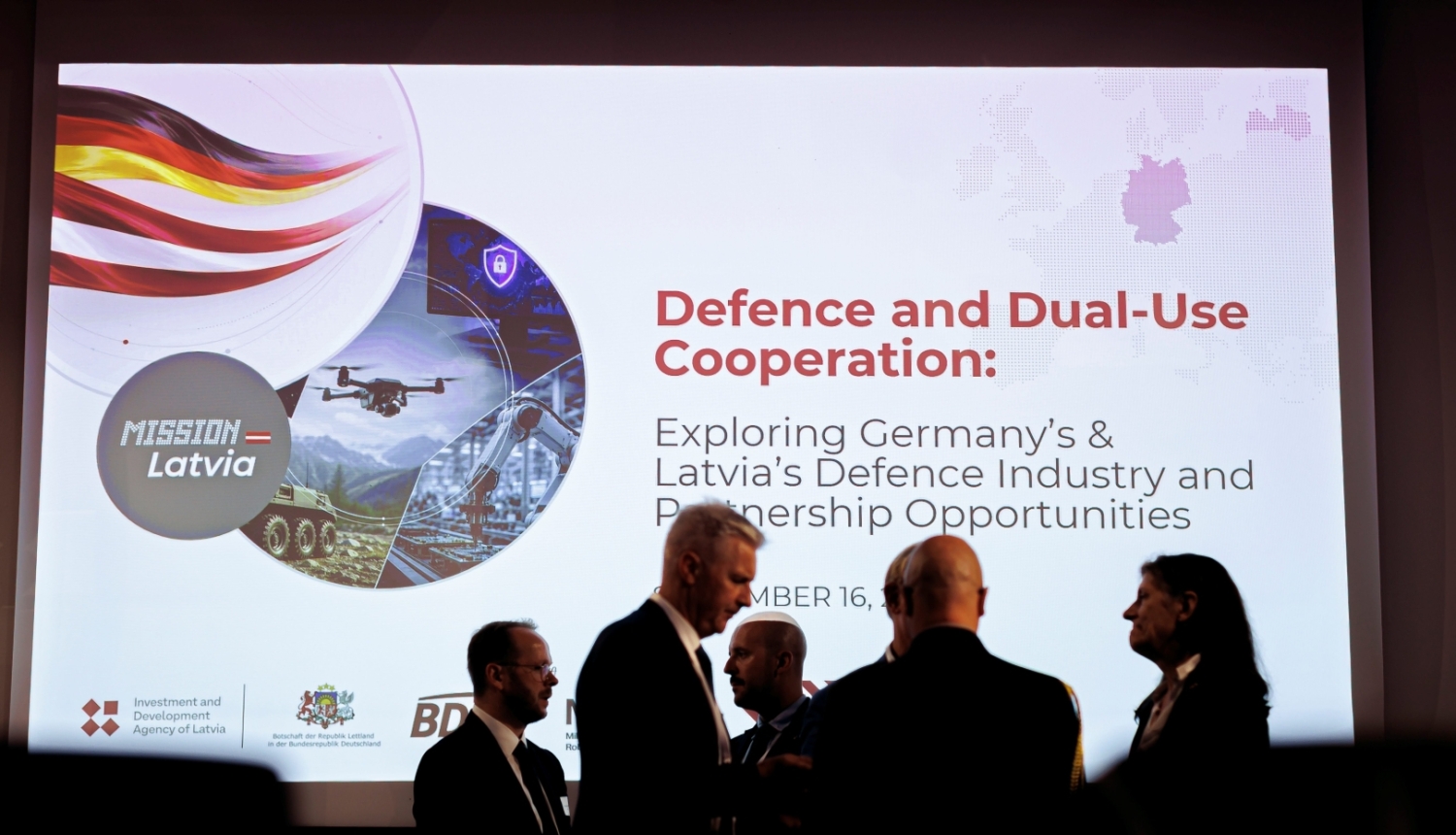
The Defense and Dual-Use Technologies Program began on September 16 with an event dedicated to cooperation between the Latvian and German defense industries, organized in collaboration with the German Security and Defense Industry Association (BDSV).
Economy Minister Viktors Valainis emphasizes: “Industrial cooperation between Latvia and Germany is becoming increasingly close—in the first half of 2026, Latvian exports of goods to Germany increased by 10%, while exports of machinery, mechanisms, and electrical equipment reached 34.3 million euros. This also serves as a manufacturing base upon which Latvia’s defense industry can grow. Our companies are capable of supplying electronic components, unmanned systems, military vehicles, metal structures, and other solutions necessary for strengthening Europe’s defense capabilities. It is now important to increasingly involve Latvian companies in German and European supply chains, as well as in joint technology development and manufacturing.” Latvian business leaders met with BDSV management, German defense companies, and a representative of the German Federal Ministry of Defense to discuss industry priorities, upcoming procurements, and opportunities for cooperation.
Direct Talks with the German Defense Industry
During an in-depth industry session, “Rheinmetall,” “HENSOLDT,” “Rohde & Schwarz,” and “Quantum Systems” presented their areas of expertise and opportunities for cooperation. The discussions focused on expanding defense manufacturing and supply chains, sensors, electronic warfare and counter-UAV solutions, secure communications, and autonomous systems. Latvia’s defense technology ecosystem was presented to German partners by Artis Pabriks, Executive Director of the Military Technology, Drone, and Robotics Association “MilTech Latvia,” and Jānis Atslēns, a representative of the Latvian Security and Defense Industry Federation.
“As ambassador, security is one of my top priorities in relations between Latvia and Germany; we cooperate both bilaterally and as NATO and EU partners. Germany is one of the world’s leading countries in the military industry, and Latvia has excellent opportunities to build closer cooperation with the German defense industry. We have qualified specialists and innovative companies capable of adapting to the changing conditions of the sector, and such long-term cooperation is based on trust and close professional ties. “The Embassy will continue to actively support Latvian companies by helping them establish new contacts, gain a foothold in the German market, and become part of the European defense industry’s supply chains,” notes Ilze Rūse, Latvia’s Ambassador to Germany.
Focus on Unmanned and Autonomous Systems
On September 17, Latvian and German companies, industry organizations, and public sector representatives participated in a roundtable discussion on unmanned aerial vehicles and counter-UAV technologies, autonomous systems, robotics, artificial intelligence, secure communications, electronics, and the resilience of defense supply chains. The event was organized by the LIAA in collaboration with “Berlin Partner,” Berlin’s economic and technology development agency, and “MilTech Latvia.”
Participants in the discussion learned about the defense technology ecosystems in Latvia and Berlin, while Latvian and German companies presented their solutions. The discussions focused on identifying specific areas for cooperation—component supply, system integration, joint product development, technology testing, and manufacturing.
“Economic cooperation between Latvia and Germany already has a solid foundation—there are more than 1,000 companies with German capital operating in Latvia. In the defense industry, Latvian companies must now demonstrate their ability to meet specific technical, quality, and delivery requirements. In Berlin, they had the opportunity to discuss these issues with potential partners and determine what steps are necessary to qualify as suppliers. “Following the mission, the LIAA will continue to work on the most promising cooperation opportunities, focusing on technology testing, supplier qualification, and cooperation agreements,” notes Vita Balode-Andrūsa, Director of the LIAA’s Export and Innovation Services Department.
Berlin is solidifying its position on the European defense and security technology map. The city is home to approximately 130 companies specializing in security and defense, and more than 400 companies whose technologies are used for both civilian and military purposes. The Berlin Senate is also developing a specialized defense technology ecosystem to bring companies, researchers, investors, and public-sector clients closer together.
The delegation also visited Andres Industries AG, a Berlin-based company that develops and manufactures thermal imaging and night vision technologies for the armed forces, police, and other security agencies.
Latvian Companies Offer Technologies and Manufacturing Capabilities
The delegation of Latvian defense and dual-use technology companies included “ALMIKO,” “Daugavpils Locomotive Repair Plant,” “Electrify,” “EMJ Metāls,” “HansaMatrix,” “Latvia Packing,” “VOLBURG,” “VORX,” and “VR Cars.”
The delegation’s offerings include a wide range of printed circuit boards and electronics manufacturing, metalworking and the production of armored structures, military ammunition packaging, large-scale 3D printing materials, military vehicles, and unmanned ground platforms. Latvian companies in Germany are seeking system integrators, clients, manufacturing partners, and opportunities to participate in German and joint European defense projects.
For example, the company “Electrify” presented the “Rocky6,” an electric unmanned ground vehicle developed in Latvia, in Berlin. It is designed to transport cargo and specialized equipment in challenging terrain, for reconnaissance, the evacuation of the wounded, as well as for the integration of communications and unmanned aerial vehicle countermeasure systems. The platform has a payload capacity of 1,200 kilograms, and its electric drive has a range of up to 150 kilometers.
“Latvian defense technology companies offer their German partners a powerful combination of flexibility, engineering expertise, and solutions tailored to real operational needs. At DK NEJET, we develop software-based defense technologies—ranging from high-speed interceptors and GPS-free navigation to the coordination of drone swarms. We combine engineering development, manufacturing, and operator training into a unified ecosystem. Combined with German industrial capacity, this creates a solid foundation for the rapid deployment of field-proven and cost-effective European defense solutions,” Olga Provotar, co-founder of DK NEJET, emphasizes the importance of participating in the LIAA trade mission to Germany.
Photos from the program's Day 1 can be found here: Latvian entrepreneurs on a trade mission to Germany—Day One
Photo gallery: Defense and Dual-Use Technology Program — Day Two
©️ Photothek/LIAA
The trade mission covers several technology sectors
The trade mission for Latvian entrepreneurs in Germany, organized by LIAA, is taking place from September 14 to 17. Fifty-three Latvian companies and organizations are participating, representing information and communication technologies, financial technologies, life sciences, as well as defense and dual-use technologies. The program is organized by sector, with company visits and joint events complemented by individual business meetings.
Germany is Latvia’s largest export market outside the Baltic states. Since 2020, Latvia’s exports of goods and services to Germany have grown by more than 40%—from 1.47 billion euros to approximately 2.1 billion euros in 2025. Last year, Latvia exported more to Germany alone than to the U.S., France, and China combined. Growth is continuing this year as well: in the first half of 2026, exports to Germany increased by 11%, while Latvia’s total exports rose by 6%. Germany is also Latvia’s largest market for service exports—in 2025, service exports reached 779 million euros. There are more than 1,000 companies with German capital operating in Latvia, with a total investment in share capital exceeding 800 million euros.
Participation in trade missions abroad is organized by the LIAA as part of the European Union-co-financed Program for the Development of Innovative Entrepreneurship in Small and Medium-Sized Enterprises (SMEs), with support from the European Regional Development Fund and state funding. A company may participate in a trade mission either by paying a fee or by receiving support to cover eligible costs.