


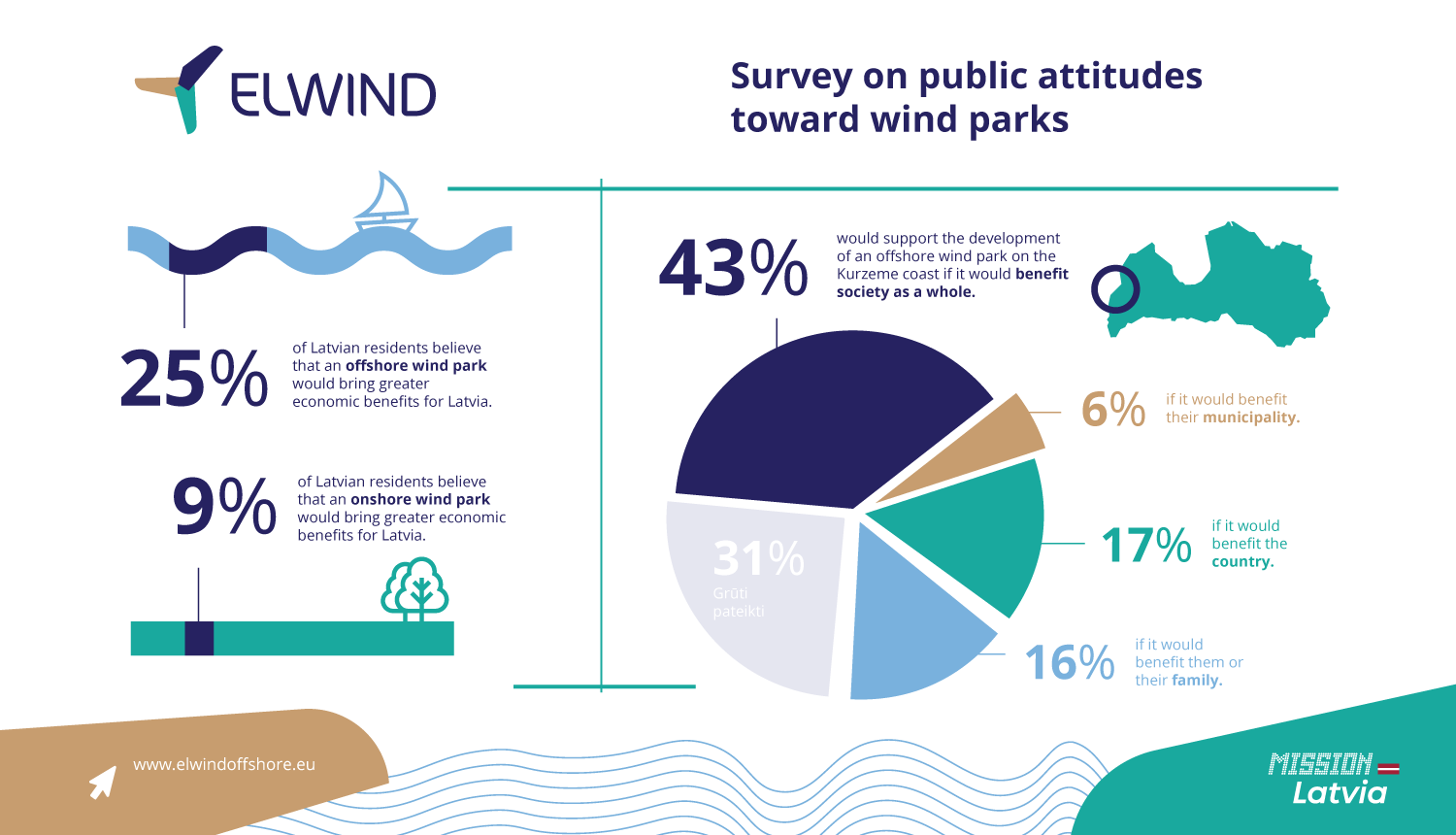
When choosing between onshore and offshore wind parks, 25% of respondents said they would prefer energy generation at sea (compared with 9% on land). Offshore wind parks receive the strongest support from young people. However, 35% of respondents would not choose either option, while 32% found it difficult to answer. These and other insights come from a survey conducted by Norstat Latvia.
An analysis of attitudes across different regions of Latvia shows that the benefits of offshore wind parks are most clearly seen by residents of Riga (30%), followed by those in Latgale (23%), Vidzeme (21%), and Kurzeme (20%). Respondents in Zemgale saw the fewest benefits (17%).
Laura Štrovalde, Deputy Director of the Investment and Development Agency of Latvia, outlines the advantages that an offshore wind park would bring:
“The joint Latvian-Estonian project ELWIND will provide Latvia with clean, domestically produced electricity, more stable electricity prices, and new jobs in the regions. It is also important to mention the research and scientific value, as the environmental impact assessment provides information that has never been researched in Latvia before. A significant share of future revenues will remain here – from port and grid infrastructure upgrades to additional income for municipalities The whole society will benefit. In addition, offshore wind energy has a higher efficiency coefficient than onshore wind energy, as it ensures more consistent operation throughout the year. With its power generation profile, this energy source would help diversify Latvia’s electricity production mix.”
Offshore wind energy – support depends on clear societal benefits
When asked about supporting offshore wind parks on the Kurzeme coast, respondents expressed a positive attitude if the beneficiaries were clearly defined. Almost half (43%) said they would support the project if it benefited society as a whole. National-level benefits were highlighted by 17% of respondents, while 16% would support the project if the advantages directly affected them or their family. Only 6% named their local municipality, and 31% found it difficult to answer.
Interestingly, different trends appear between genders: 31% of men said that offshore wind parks offer greater economic benefits, compared with19% of women. In terms of age groups, the economic potential of offshore wind energy is recognised most strongly by younger respondents: 40% of those aged 18-29 and 25% of those aged 30-39 said that offshore wind parks provide greater economic benefits.
At the same time, in older age groups, responses such as “none of the above” and “hard to say” increase significantly. This may indicate that the issue is less relevant to them, or that targeted communication and explanation are needed.
“The survey data show that offshore wind energy is perceived as more promising than onshore energy, while public support depends on clear, visible benefits. There are also notable differences in perception between genders and age groups, which allows for more accurate communication by addressing the issues that matter most,” says Laura Štrovalde.
The survey was conducted in November 2025 on behalf of the Investment and Development Agency of Latvia. Detailed survey data in Latvian can be found here.
About ELWIND
ELWIND is a cross-border project between Latvia and Estonia to construct an offshore wind park in the Baltic Sea. It is an ambitious and environmentally friendly renewable-energy initiative with a combined capacity of up to 2 GW, which will increase the region’s energy independence and security, keep energy prices reasonable, and reduce costs for businesses and households. In will also create new business opportunities.
ELWIND will help close the gap in domestic large-scale renewable energy production and contribute to a better-functioning open energy market. The offshore wind park is expected to be built and operational by 2035.
Pre-development work for the ELWIND project will conclude in 2029, followed by a planned auction in which the right to use the offshore wind site will be transferred to a qualified developer. The ELWIND project is being implemented by the Investment and Development Agency of Latvia and the Estonian Environmental Investment Centre, in cooperation with the Ministry of Economics of the Republic of Latvia and the Ministry of Climate of the Republic of Estonia.